
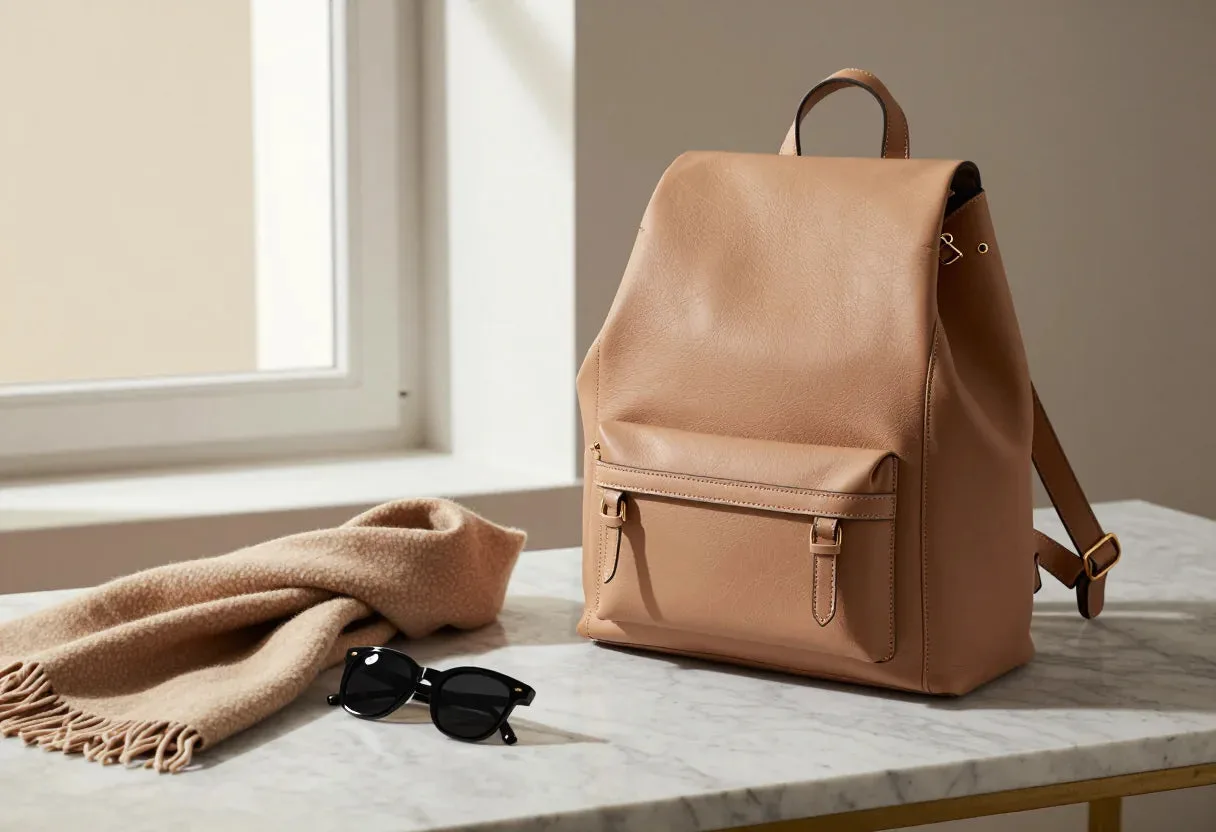
The best leather backpack for women is not the one with the nicest color or the softest leather. I learned that when my first one gave out. It cost me €180 (about $210) and lasted fourteen months. The left strap tore off one morning on the metro, all at once, without warning. The leather itself was perfect. It was the stitching that had failed.
It took me a long time to understand what had happened, and above all to understand that I had looked at the wrong things when I bought it. I had focused on the color, the shape, the feel of the leather under my fingers. I had not spent three seconds looking at the exact spot where the bag was going to break.
What I share here is what I wish someone had told me then. It is not a ranking, and I do not claim to have tested everything out there. These are the things I learned buying leather backpacks for women, breaking some of them and keeping others much longer than I expected.
- Why I switched to a backpack, and why I stayed
- What “genuine leather” really means
- What size leather backpack you need
- The three places I check before I buy
- Comfort, the thing you notice in the third week
- Color: what I learned by choosing it badly
- How much I ended up willing to spend, and why
- What I check in thirty seconds on a product page
- The questions I get asked most
Why I switched to a backpack, and why I stayed
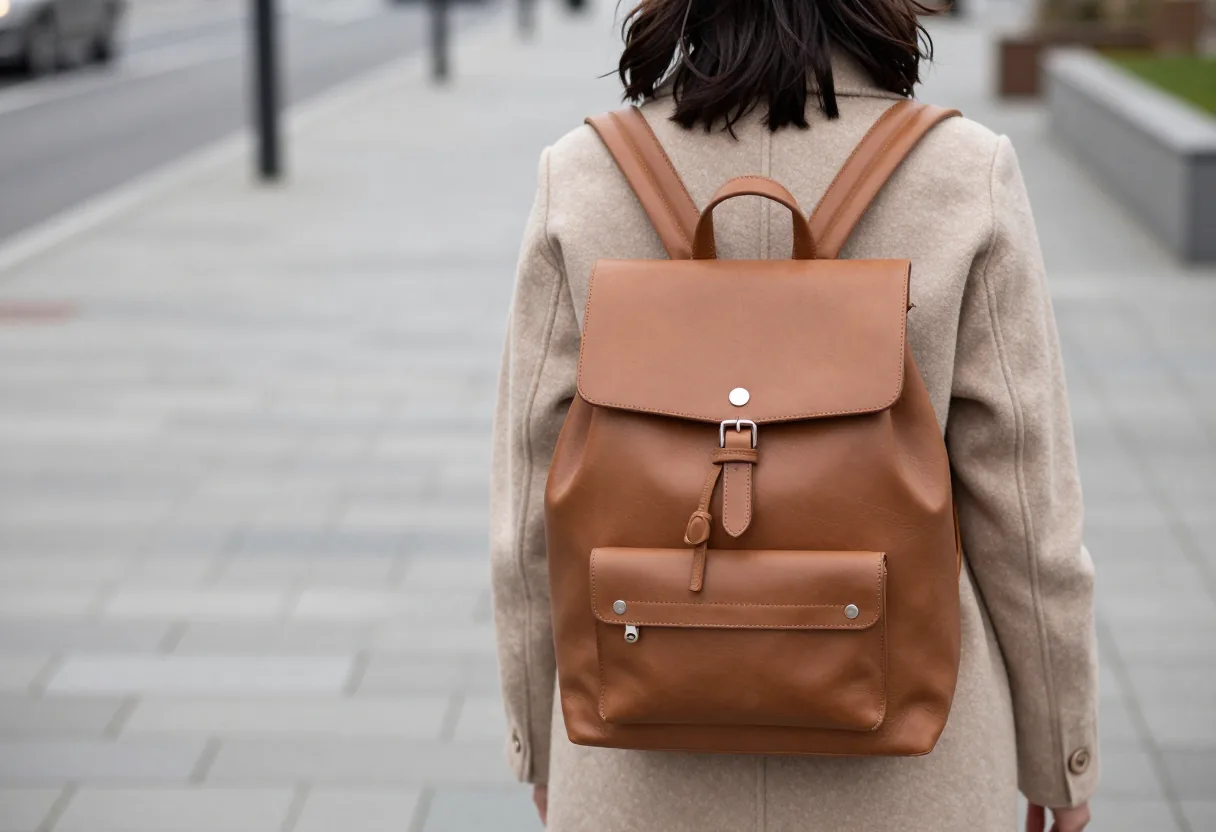
The trigger was nothing glamorous. A move, three boxes of supplier documents to bring home from the office, and the handle of my handbag giving out on the sidewalk. I borrowed a backpack that day for lack of anything better.
I did not think I would get used to it. In my head, a backpack meant middle school. I tried a slightly structured black leather one, a little reluctantly, and I never went back. What won me over was not even my back, it was having my hands free. Finding my transit pass, holding a coffee, opening a door, everything gets easier.
What I underestimated was how long it takes to get used to the look. For the first three weeks, I felt everyone saw a hiker’s bag. Nobody noticed a thing. The only one who found it strange was me.
Today I have three, for different uses. That may be two too many, but each has its reason. Our selection of women’s leather backpacks covers roughly those three cases.
What “genuine leather” really means
After the strap story, I bought a replacement for €55 (about $65), telling myself that since even an expensive bag breaks, I might as well pay less. The label said genuine leather. That reassured me.
After eighteen months, the surface started to peel. Not to develop a patina, to peel, literally, in small flakes, like chipping paint. I eventually learned why, and it is the most useful thing I can pass on here.
What the label hides
“Genuine leather” means the bag is made of animal hide. Nothing more. That includes split leather, the lower layer you get by splitting the hide, which is weaker and is often coated to look like grain leather. That coating was what peeled on my bag. The label was perfectly accurate, and perfectly misleading.
What the rules say in the US
The Federal Trade Commission’s guides for leather and imitation leather products cover handbags, purses and similar articles. They say the word “leather” on its own should only describe a product made of leather in all substantial parts. A material that looks like leather but is not should be disclosed as such, for example “imitation leather” or “vinyl”, and bonded leather, made from ground leather fibers, should not be presented as leather. Where it is named, its share of leather fibers should be stated.
What the guides do not do is rank leather. They define no “genuine leather” grade and no order between full-grain, top-grain and split leather. So “genuine leather” tells you the bag is real leather, not which layer of the hide it comes from. The Leather Working Group’s glossary gives the terms the trade uses: full grain is leather that has kept its entire grain, corrected grain has had its grain partly buffed away and then finished, and split leather comes from the lower layers of the hide.
What I look for now
The words full-grain leather. It is the top layer of the hide, kept intact, with its natural grain. A seller who made that choice says so, because it costs more. A seller who stays vague usually has a reason to.
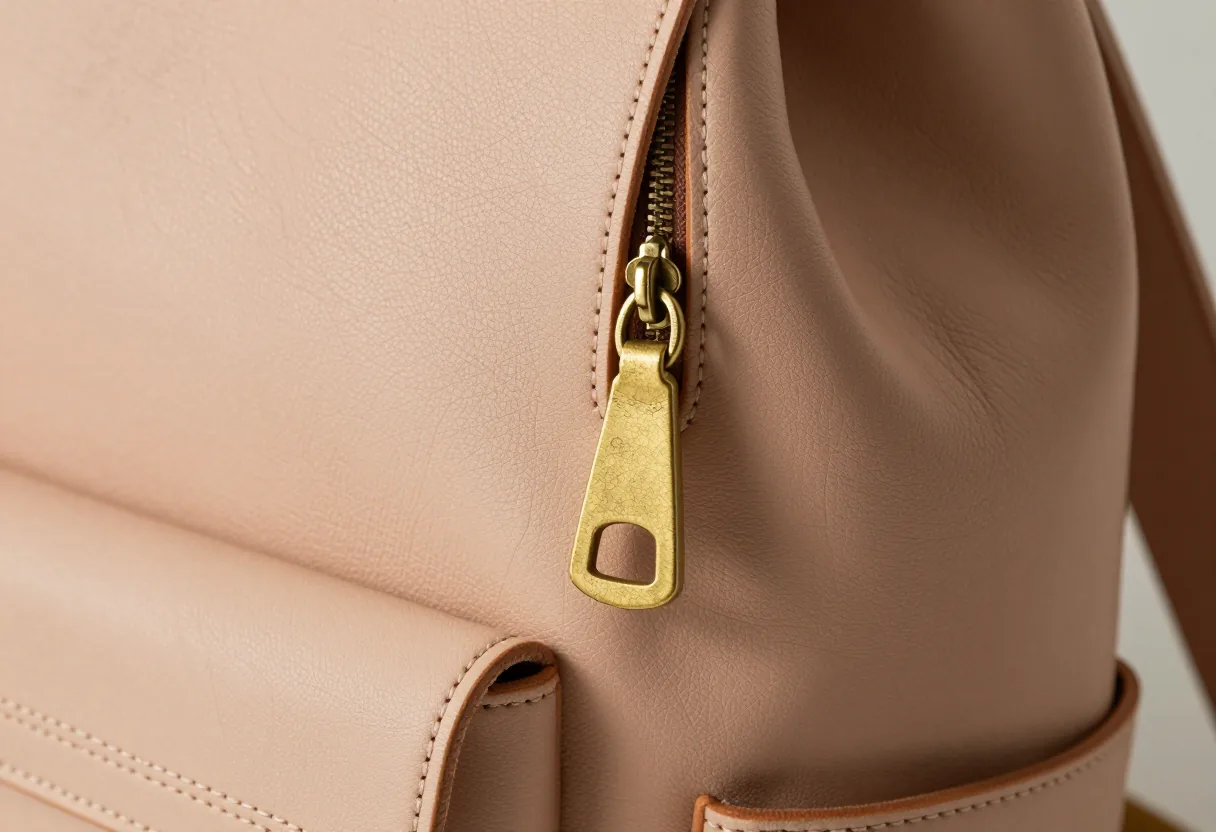
You can see the difference once you know what to look for. On full-grain leather, the grain is never perfectly even. You sometimes see fine marks or a change in texture. On corrected and pigmented leather, everything is uniform, almost printed. It looks neat and regular, and it will hardly develop a patina.
And vegan leather?
I had one, made from cactus fiber, bought with good intentions. It lasted three years, which is fair. But I am no longer so sure about the environmental argument. It is polyurethane on a fabric backing, with a plant-based share. It is still a plastic, and it ends up in the trash. A leather bag I keep for ten years seems to me less costly for the planet in the end, but I accept that the debate is not settled and that I am not the best person to settle it.
The ones I keep longest are in full-grain genuine leather, like our women’s sheepskin leather backpack, and in handcrafted leather, like our handmade leather backpack.
What size leather backpack you need
I always go too big. I know it, I tell myself every time, and I do it again. The “just in case” logic is hard to fight when the bag is in front of you.
The problem is that a half-empty bag sags. The shape I loved in the store disappears as soon as I carry it with just a wallet and a notebook inside. It droops. That is exactly what gives the sloppy look you were trying to avoid.
What I do now, and it works, is to aim for a bag I fill to eighty percent on a normal day. Not the exceptional day when I take files and a pair of sneakers. The normal day.
- 5 to 10 liters: phone, wallet, keys, a small pouch. It is my Saturday bag. It is not for anything else, and that is fine.
- 10 to 15 liters: the size I use most. Add a water bottle, a book, a scarf. No laptop.
- 15 to 20 liters: the work size, with a 13 or 14 inch laptop and its charger. I tried less than 15 liters with a laptop, and there was no room left for anything.
- Over 20 liters: in leather, be careful. My biggest weighs 1.2 kg (2.6 lb) empty. I found out the day I put it on a scale, partly out of curiosity, partly because it felt heavy.
One detail cost me a return. Measure your laptop, thickness included, and compare it with the inside dimensions of the compartment. Not with the advertised inches. My 15.6 inch laptop did not fit in a bag sold as fitting 15 inches. On paper, it worked.
For everyday city use, the women’s lambskin leather backpack is the size that matches what I use most. For volume, see what size backpack you need, in liters.
The three places I check before I buy
Since the torn strap, I have a little routine. It takes a minute and it has saved me from two bad buys.
1. Where the straps meet the bag
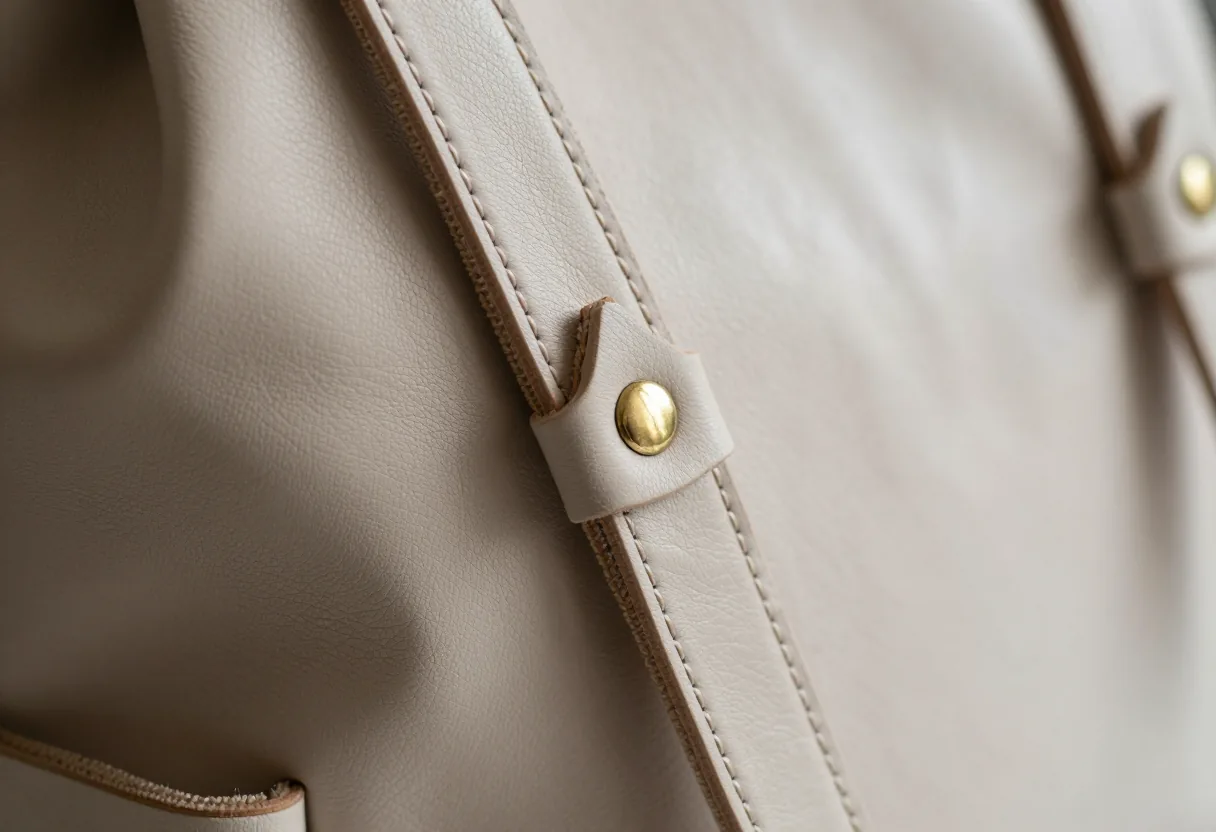
Everything goes through there. I look for visible reinforcement: a triangle or box stitch, or a metal rivet. On my broken bag, there was just a single straight seam. I did not know it then, but it was written on the bag, in a way.
2. The edges of the leather
The detail that gives everything else away. On a carefully made bag, the cut edges of the leather are dyed and polished, smooth to the touch. On a rushed one, they are raw, rough, sometimes already fuzzy in the store. It is slow work, and nobody does it on a piece where everything else was rushed. I always run my finger along them now. It looks a little silly in a store, but it works very well.
3. The zipper
I open and close it five or six times with the bag empty. If the pull catches when the bag is empty, it will catch ten times more once the bag is full. On the three bags I wore out completely, it was always the main zipper that failed first, never the leather.
The finish on the edges and the hardware is what really sets a luxury leather backpack or an elegant quilted faux leather backpack apart from the rest.
Comfort, the thing you notice in the third week
In the store, every bag is comfortable. They are empty and you wear them for thirty seconds. The real test comes later, and it does not lie.
I have a beautiful bag, bought on impulse, with thin unlined leather straps. It went into the closet after three weeks. They dig into my shoulders as soon as the bag weighs more than about 3 kg (6.5 lb). I never sold it, which says a lot about how I feel about that purchase.
What I look at now:
- Strap width. At least 4 cm (1.5 in). Narrower straps leave marks.
- Padding, even thin. A bare leather strap gets uncomfortable within half an hour, I have checked.
- Shape. Straight straps slide toward the outside of my shoulders all the time. Curved straps do not. It took me years to understand that I was not the problem.
- Adjustment. The bottom of the bag should sit at the small of your back. Worn lower, it pulls you backward and you end up leaning forward without noticing.
My test, when I can, is to load the bag with what I really carry and walk for five minutes. Almost every flaw shows up before the five minutes are over.
Color: what I learned by choosing it badly
I bought a light cognac bag that I found bright. Two years later it is clearly darker, and the areas that rub, at the corners and under the flap, are almost brown.
The funny thing is that I prefer it now. But it was not the bag I had chosen, and if I had needed it to stay the same, I would have been disappointed. Unfinished full-grain leather darkens, that is its nature, and you have to want it.
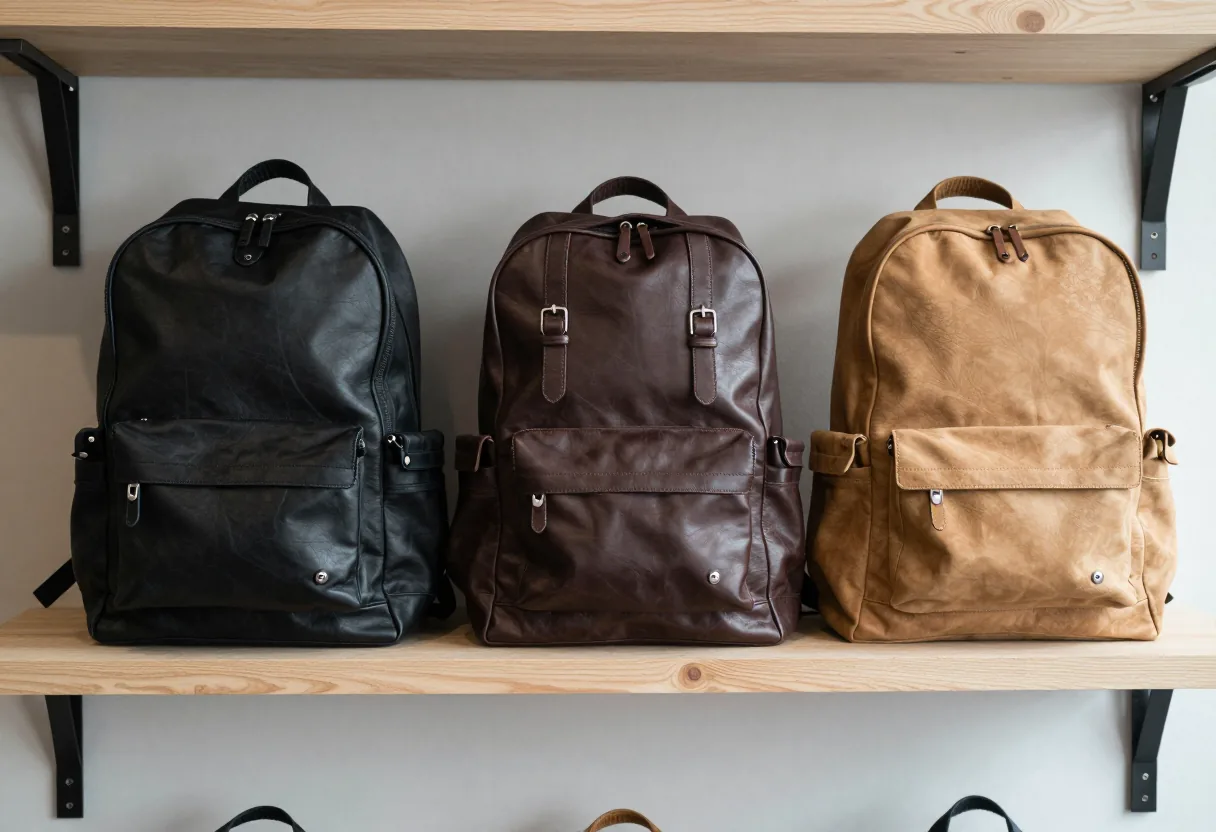
- Camel and cognac change the most visibly. Choose them knowing they will change, or you will be disappointed.
- Black forgives everything and hardly changes at all. It is my work bag, without hesitation.
- Dark brown and taupe are the compromise, discreet without being severe. I think it is what I would recommend if someone asked me for just one bag.
- Bright colors work on a small backpack, worn like a piece of jewelry. On a big bag, it is all anyone sees.
How much I ended up willing to spend, and why
One day I did the math, partly out of curiosity, partly to justify a purchase. My black bag cost me €165 (about $190) and I have had it for six years. That is €27 a year. The €55 bag that peeled, replaced after eighteen months, came to €37 a year, plus the annoyance of replacing it.
That math changed how I see price. Here is how I place the price ranges, knowing they are rough orders of magnitude and not a rule. They are in euros, where I bought my bags, with the dollar figure rounded.
- Under €60 (about $70): faux leather or coated split leather, in my experience every time. Fine for occasional use. Not for every day.
- €60 to €120 (about $70 to $140): real leather, often corrected grain, with honest finishing. This is where the best value is for daily use.
- €120 to €250 (about $140 to $290): full-grain leather, solid hardware, finished edges. This is the range where I stopped getting bad surprises.
- Above that: I have not seen a difference in durability that justifies the gap. It may be true for some houses, I simply have nothing to back it up.
What I check in thirty seconds on a product page
When I buy online, this is the order I read things in, and what makes me close the tab.
- Is the type of leather stated? If the page only says “genuine leather” with no other detail, I move on. It is not always bad, but I would rather not gamble.
- Are the inside dimensions given? Not the size in inches. The actual measurements. That is what cost me a return and two weeks of waiting.
- Is the empty weight listed? Rarely, sadly. When it is, it is a good sign, as it means there is nothing to hide.
- Do the photos show the straps up close? A brand that never photographs its strap attachments often has something not to show.
- Is there a quick-access pocket? A bag that only opens from the top makes me empty everything to find my badge in a hallway. It sounds like a detail, it is not.
The questions I get asked most
How can you tell if a backpack is real leather?
Three clues that, together, usually tell you. First the smell. Leather has a rich, slightly animal smell, and faux leather smells of plastic or of nothing. Then the touch. Leather warms up in your hand and creases into irregular wrinkles when you press it, while faux leather stays cool and folds in regular creases. And finally the edge. On leather the cut is fibrous, while on faux leather you can clearly see a plastic layer on a fabric backing.
Can a leather backpack handle rain?
A shower, yes, no problem, as I have found out more often than I would like. Long exposure leaves water marks and dries the leather out as it dries. My reflex is to blot it right away with a dry cloth, without rubbing, let it dry away from any heater and condition it once it is dry. On days when the weather is really bad, I take another bag, from our waterproof backpacks collection.
What size leather backpack for work with a laptop?
15 to 20 liters with a padded compartment. I tried smaller, and the laptop took up everything, with no room left for the charger and my things.
Which brand makes the best leather backpack for women?
There is no single best brand, and the names in “best of” lists change every year. What separates a good maker from a weaker one is what it tells you. The leather is named precisely (full-grain, corrected grain or split), the strap attachment is shown up close, the zipper and hardware are described, and the guarantee is stated. When a product page says none of that, I take it as a warning, whatever the brand.
Do leather straps stretch over time?
A little, yes, and that is normal. On my good bags, it settled after a few weeks and the adjustment was enough to make up for it. On one bag where the straps kept stretching after six months, the leather was too thin. It is a sign I take seriously now.
Can you wash a leather backpack?
Never in the washing machine, and never by soaking it. A barely damp cloth, a soap made for leather if needed, then a conditioner. I go through the whole routine in my guide on how to clean a leather bag or backpack, and for fabric bags, it is covered in how to wash a backpack.
What I take away, six years later
If I had to sum up in one sentence what the torn strap taught me, it would be this. The leather is almost never what fails. It is the stitching, the zippers, the attachment points. That is where you need to look, and it is exactly where you do not look when you are falling in love with a bag.
The other thing is that I got it wrong almost every time I bought in a hurry. The bags I still use are the ones I took my time choosing. It is not a universal rule, it is just what I see when I look in my closet.
And take care of yours. Two coats of conditioner a year is twenty minutes a year. My black bag is on its twelfth and it does not have a single crack.