
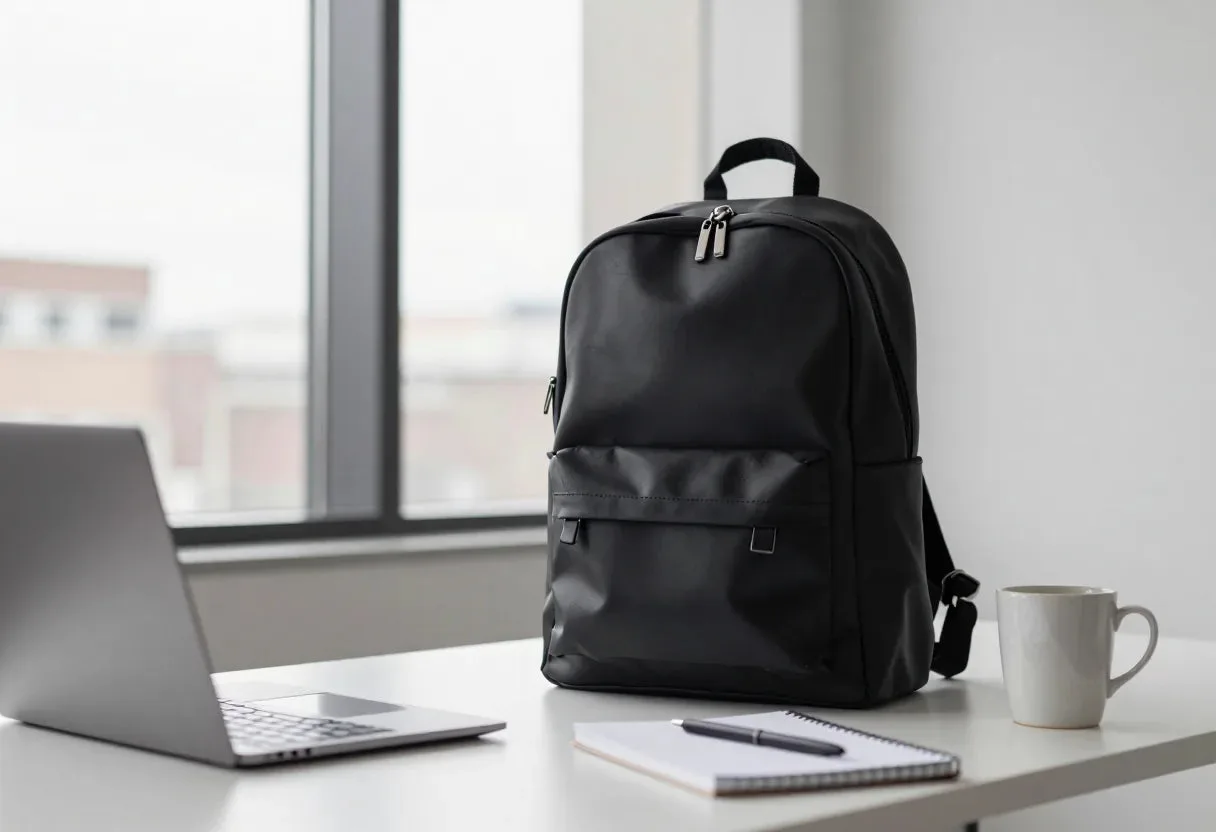
For two years, until I went looking for the best work backpack for women, I spent forty minutes a day on public transport with a 15.6-inch laptop in a handbag worn on my right shoulder. I am not telling you this for the sake of a story. It is what sent me to a physio, and it is what made me switch to a backpack even though I found them inelegant.
What I had not anticipated was how many wrong choices there are. My first work bag was too small. The laptop filled it, I put my lunch on top and crushed the screen. The second was the right size but only opened from the top, and every morning I emptied half the bag to find my staff pass in front of the turnstile.
The third is the right one, and I have had it for four years. Here is what I have learnt since about what really matters in a work backpack for women.
- Why a work bag is not a city bag
- The laptop compartment, the mistake I paid for twice
- What size work backpack? Fifteen to twenty litres, no more
- Inside organisation, the part you feel every morning
- Comfort on a daily commute, measured in weeks
- Leather, nylon or canvas: which makes the best work backpack for women
- How others see it, the part nobody talks about
- Security and rain: where I paid extra for nothing
- Questions I get asked about work backpacks for women
Why a work bag is not a city bag
This is the first thing I got wrong. I chose my work bag the way I would have chosen a bag for a Saturday out, by looking at its lines and its material. But the constraints are not the same at all.
A city bag gets filled now and then. A work bag carries the same weight, on the same journey, five days a week, for years. That regularity changes everything:
- Carrying comes before looks. Three kilos carried for twenty minutes a day soon make themselves felt. My second bag was prettier than the third, and it is in the cupboard.
- Quick access becomes central. The staff pass, the phone, the travel pass. I do not want to open the main compartment in a metro corridor at rush hour.
- The laptop is non-negotiable. It is the most expensive and the most fragile thing in the bag, and it is the one we protect least well.
- The bag has to stand up on its own. A bag that slumps on the floor next to my desk gives a very different impression from one that stays upright. It sounds silly, but it shows.
The laptop compartment, the mistake I paid for twice
Two bad buys, on the same subject, for two different reasons. They may as well be of use to someone.
Inches mean nothing
The first time, I ordered a bag advertised as “15-inch compatible” for a 15.6-inch laptop. On paper, it seemed to fit. In reality, the machine was two centimetres too wide and did not go in at all. It took two weeks of returning it and waiting for the refund to understand that inches measure the diagonal of the screen, not the size of the device.
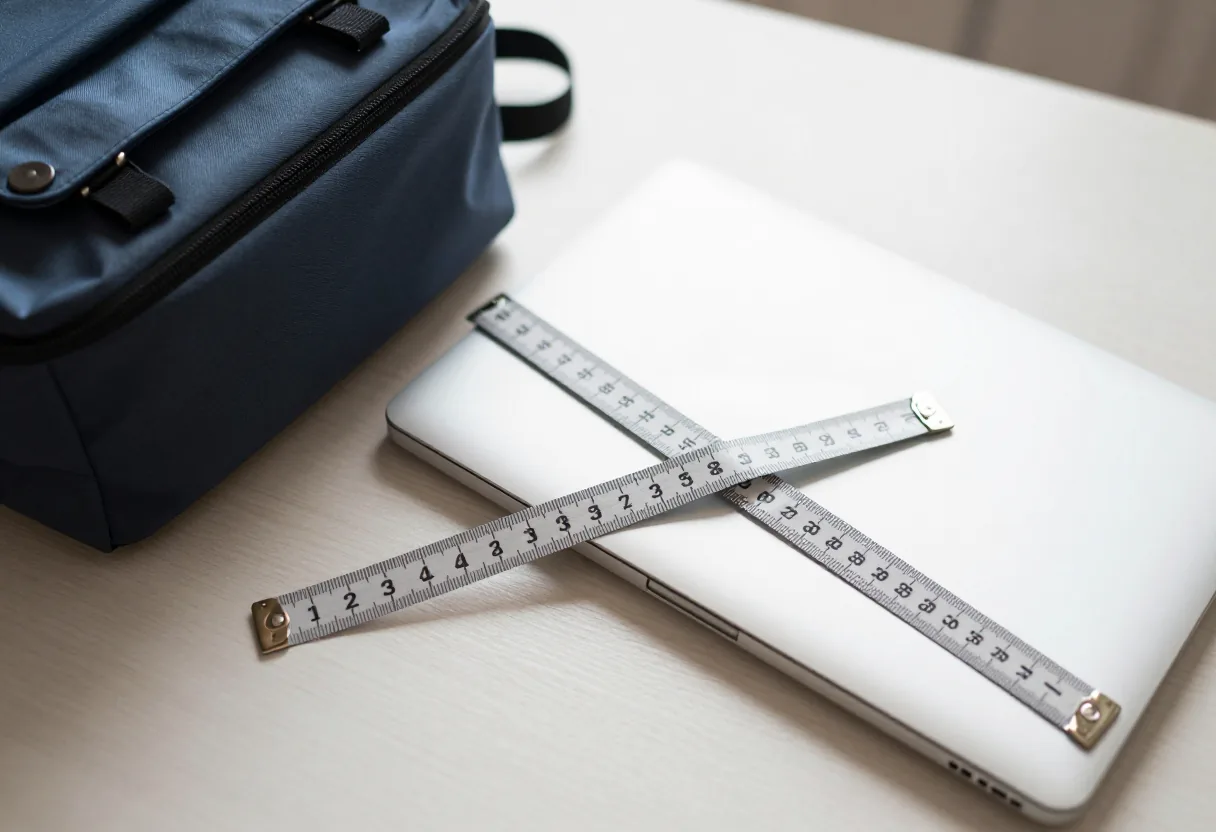
Now I measure my laptop in length, width and thickness, and I compare those figures with the inside dimensions of the compartment. If the product page does not give those centimetres, I take it as a bad sign and move on. It may be excessive, but I have not got it wrong since.
The bottom of the compartment
The second time, the bag was the right size but the compartment went all the way down to the bottom of the bag. Every time I put the bag down a little too quickly, the laptop took the knock. The lower corner of the casing was dented after a year.
What I have looked for since is a base raised by two or three centimetres, and foam padding at least eight millimetres thick on the sides. A strap with a clip that holds the laptop in place is a bonus. Without it, the laptop slides and bumps with every step, which you hear very clearly on a staircase.
Our collection of laptop backpacks for women brings together the models with a real dedicated compartment.
What size work backpack? Fifteen to twenty litres, no more
I have tried smaller and bigger, and I came back to the middle.
- Under 15 litres: my first bag. Workable with a 13-inch laptop, unmanageable with a 15.6. The laptop took up all the room, my lunch ended up on top, and I crushed it when I closed the bag.
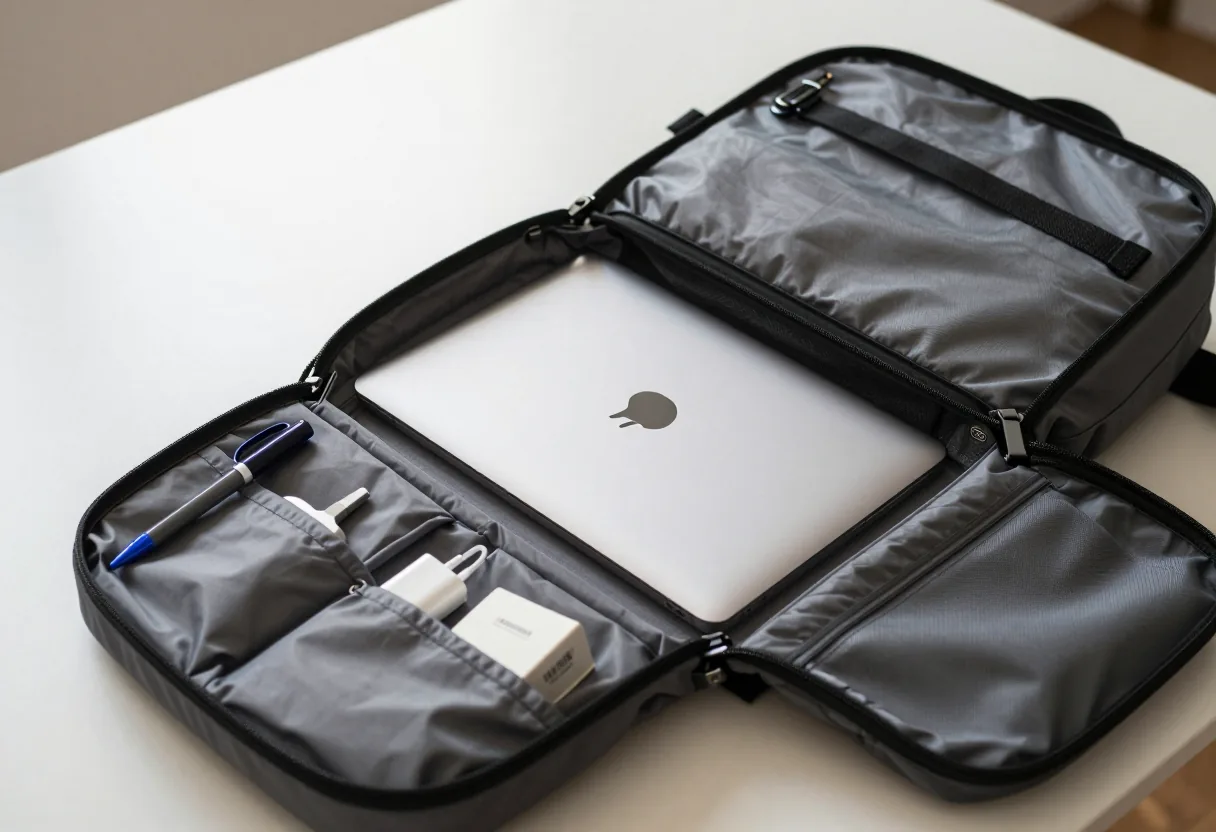
- 15 to 20 litres: what I use. Laptop, charger, notebook, pencil case, water bottle, scarf, and there is still room to spare. It is the size that has never let me down.
- 20 to 25 litres: useful if you carry gym kit, or if you sometimes go away for a night. I had this size, and I found it bulky on public transport.
- Beyond that: it is a travel bag. It looks odd in a meeting and it gets in everyone’s way in a packed carriage.
One figure I look at now, and never used to, is the empty weight. My twenty-litre leather bag weighs 1.2 kg before anything goes in. A nylon equivalent weighs 600 grams. Over a forty-minute daily commute, that difference is not theoretical.
Inside organisation, the part you feel every morning
The bag I had to empty to find my staff pass taught me this better than any comparison could. With one single large compartment, everything ends up at the bottom, jumbled together. But too many pockets is another trap. My gym bag has so many compartments that none of them takes a ring binder.
What works for me:
- A main compartment wide enough for an A4 sheet laid flat.
- A separate laptop compartment, against the back.
- A front organiser with two or three loops for pens, a space for the charger, and a zip pocket for the small things that get lost.
- A quick-access outside pocket for the phone and the travel pass. It is the one I missed most, and the one that solved my turnstile problem.
- A stretchy mesh side pocket for the water bottle. In stiff fabric, my bottle does not fit.
Something I discovered by chance is that the pocket lying flat against your back, the one you cannot reach while the bag is on, is the safest place for a wallet on a crowded metro. I had never thought of it until a colleague pointed it out. Our small faux leather multi-pocket backpack for women follows the same idea of storage by zones.
If your job takes you away by train or plane, one more detail is worth checking. A strap across the back panel lets the backpack slide over the handle of a suitcase, so it rides on your luggage instead of your shoulders. Our 16 inch laptop backpack for women has one.
Comfort on a daily commute, measured in weeks
In a shop, every bag is comfortable. They are empty and you wear them for thirty seconds. The differences show up in the third week, and by then they are brutal.
The shoulder straps
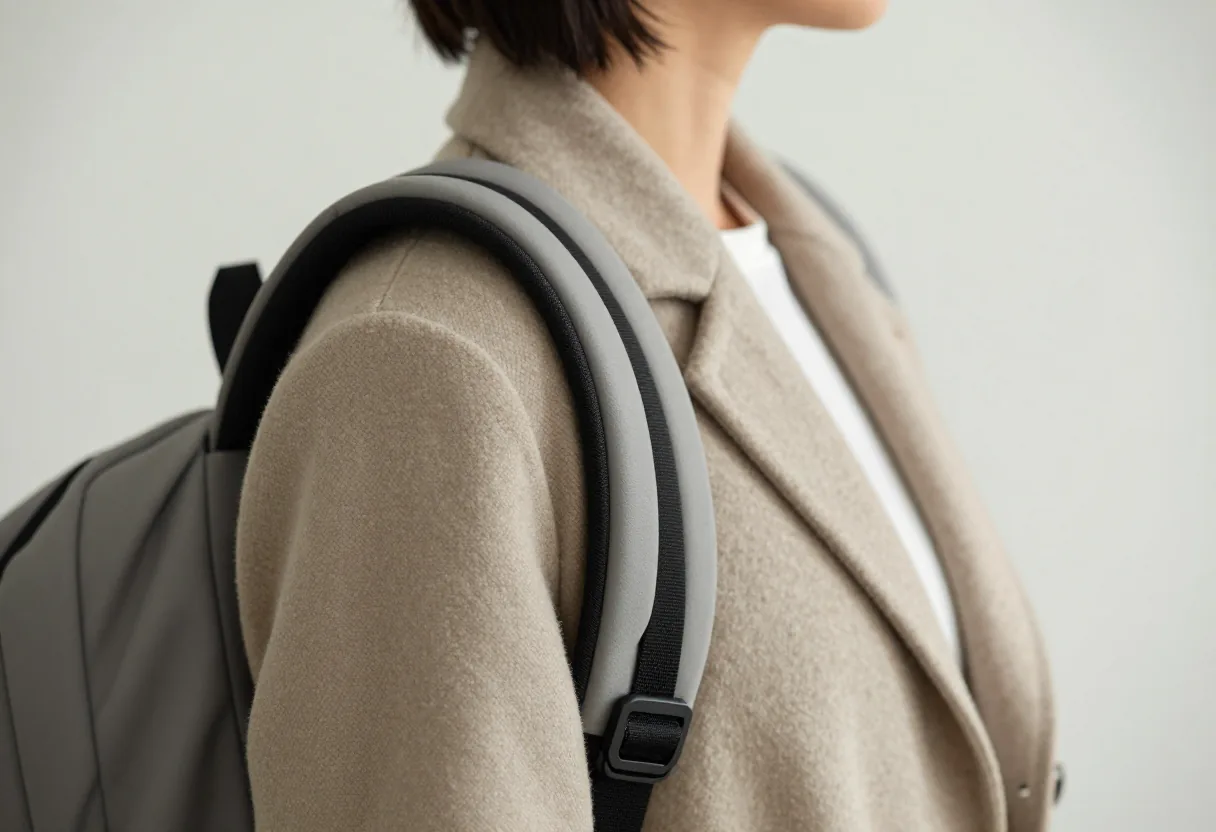
Four centimetres wide, at the very least. And above all, curved. It took me years to understand that straight straps slipped off the outside of my shoulders not because I was adjusting them badly, but because they are designed for shoulders broader and squarer than mine. Switching to curved straps put an end to a daily annoyance I thought I had to live with.
The back panel
This is the weak point of my leather bag, and I accept it. Leather does not breathe. After fifteen minutes of walking in summer, my back is damp. Models with a ventilated mesh back panel are frankly better on this point, even when the rest of the bag is leather.
The chest strap
I used to find it ugly and pointless. I have one now, a detachable one, and I clip it on as soon as the bag goes over four kilos. It is what stops the shoulder straps from slipping. I take it off before I get to the office, which may be a little ridiculous, but it works very well.
How high to wear it
The bottom of the bag should sit in the small of your back. Worn lower, it pulls you backwards and you make up for it by leaning forward without realising. My physio showed me on a photo taken from the side, and I was not standing at all the way I thought I was.
The same goes for the size of the bag itself. Many backpacks are too broad in the straps or too long in the back for a woman’s frame, which is why guides to work backpacks for women look for models made for narrower shoulders and a shorter torso.
Leather, nylon or canvas: which makes the best work backpack for women
I own all three, which is not reasonable, but it lets me compare them honestly.
- Leather holds its shape, ages well and fits in anywhere in a formal setting. It is heavier and more expensive, and it needs conditioning twice a year. It is my bag for the days when I have meetings outside the office. The elegant quilted faux leather backpack belongs to this family.
- Technical nylon is light, does not mind the rain, cleans in two minutes and almost always has more pockets. If I am honest, it is the one I take most often. It looks a little sporty, which does not bother me in my line of work. Our elegant backpack for women, designed for work, is made of waterproof nylon and takes A4.
- Canvas is a pleasant middle ground and warm to the eye, but it shows the dirt, and there has been a coffee stain on mine for two years.
- Leather and canvas combinations are probably the best compromise, objectively speaking. They use leather on the parts that give the bag its structure and lighter canvas everywhere else. If I had to buy just one bag again, that is probably where I would go.
How others see it, the part nobody talks about
This is what held me back most before I switched, and it is what the guides talk about least. I work in a fairly formal environment and I was afraid of looking like a student.
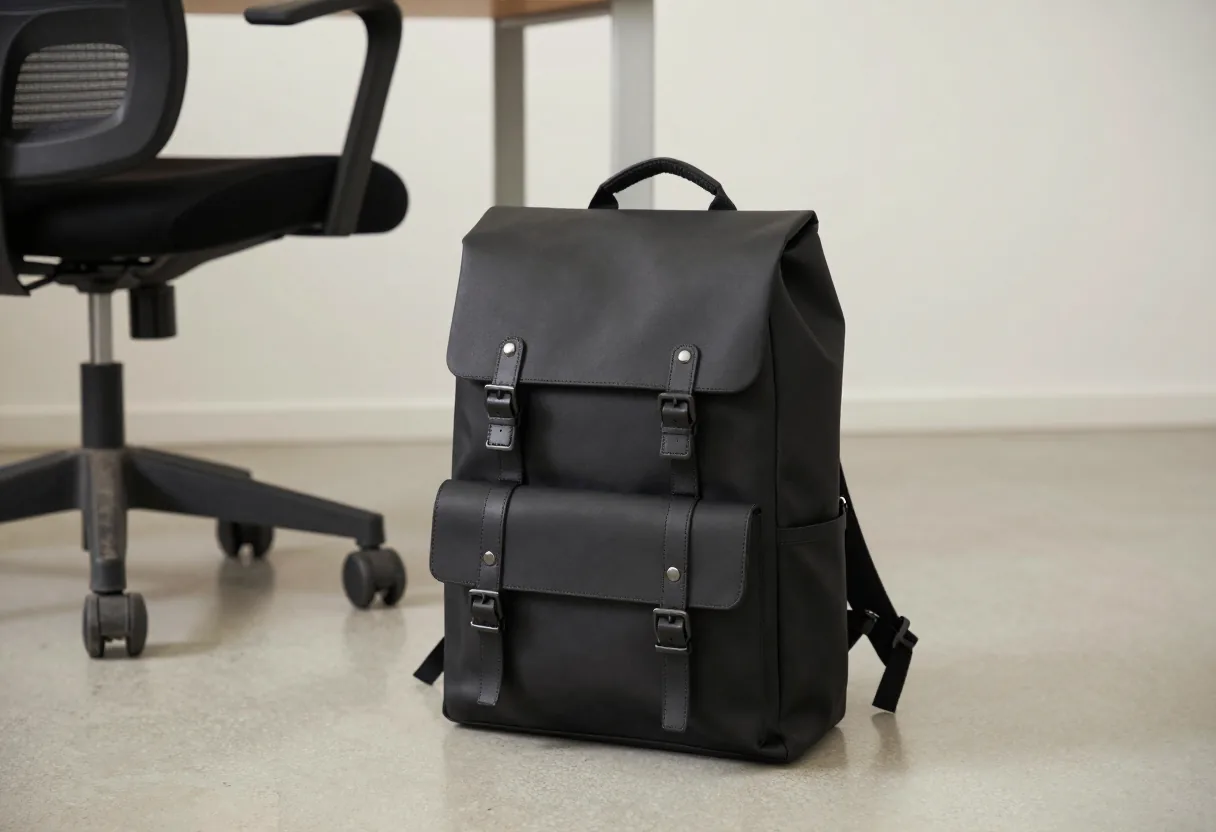
What I have seen over four years is that nobody has ever made a remark. What people notice is not the fact that you carry a backpack, it is the shape of the bag. A soft model with dangling straps, bright colours and visible technical details stands out. A structured bag in smooth leather, with no logo, reads as a leather accessory.
Depending on the setting, as I have seen it around me:
- Formal (law, finance, consulting): smooth black or dark brown leather, a structured shape, discreet hardware, no logo. It should be able to sit next to a briefcase without looking out of place.
- Creative and tech: anything goes, and the only constraint left is practical. I am a little envious of that.
- Healthcare, teaching, fieldwork: washable comes first. Two friends of mine who are nurses both carry nylon, and that is no coincidence.
- Remote and hybrid working: the bag is used twice a week. Lightness matters more than toughness.
Security and rain: where I paid extra for nothing
I paid extra for an anti-RFID lining. Looking back, I would not do it again. Contactless skimming from a distance does technically exist, but the range is a few centimetres and the amounts are capped. A shielded pouch costs a few euros (a few pounds) and slips into any bag.
What does have real value, if you travel on crowded public transport, is a hidden zip, or at least an inside pocket that is hard to get at. If the subject really worries you, our anti-theft backpacks collection is made for exactly that.
On rain, I would separate two things I used to confuse. Water-repellent fabric lets a ten-minute shower run off, which covers almost all of my journeys. Waterproof means sealed seams and a protected zip, which is another budget altogether. The point that really matters, which I learnt when I found my charger wet, is that the laptop compartment is protected from water getting in through the main zip.
Questions I get asked about work backpacks for women
Does a backpack look scruffy at the office?
Not in my experience, as long as you choose a structured, understated model. What gives away the wrong bag is a slouchy shape and visible technical details, not the idea of a backpack itself. Nobody at the office has ever commented on mine.
What size backpack for a 15.6-inch laptop?
Twenty litres at least, and a compartment of at least 38 cm by 27 cm. Do not rely on the “15 inch” label. That is precisely the mistake that cost me a return.
Backpack or messenger bag?
Over three kilos or ten minutes of walking, the backpack, without hesitation. The messenger bag keeps the edge for a car journey, or when you put your bag down and pick it up several times an hour. I have kept a slim messenger bag for the days when I leave the laptop at home.
How do you wear it with a structured coat?
It works, with the straps let out a little longer than in summer. One thing to watch, which I found out the hard way, is that dyed leather straps can leave marks on a light wool coat. Since then, when I wear my beige coat, I take the bag with fabric-lined straps.
How long does a work backpack last?
My entry-level nylon bag lasted two and a half years of daily use. My leather bag is in its fourth year and there is nothing wrong with it. What gives way first, in my experience, has always been the main zip or where the straps are attached. Never the material.
How to choose the best work backpack for women: what I would tell a beginner
Look at the laptop compartment first, in centimetres and not in inches, and check that it does not go all the way down to the bottom of the bag. Go for fifteen to twenty litres. Look for wide, curved shoulder straps. And insist on a quick-access front pocket. It is what will save you from emptying your bag every morning.
Style comes second, and it depends on your workplace more than on your taste. An elegant bag that hurts your shoulders ends up in the cupboard. I have the proof at home.
One last piece of advice, perhaps the only one that really counts. Try the bag loaded with the real weight of your day, and walk for five minutes. Everything that will annoy you for three years shows itself in those five minutes.
Further reading
- The Women’s Chic 16 Inch Laptop Backpack, for 11 to 16 inch laptops, in waterproof nylon
- Our leather backpacks for women
- Our women’s laptop backpacks