
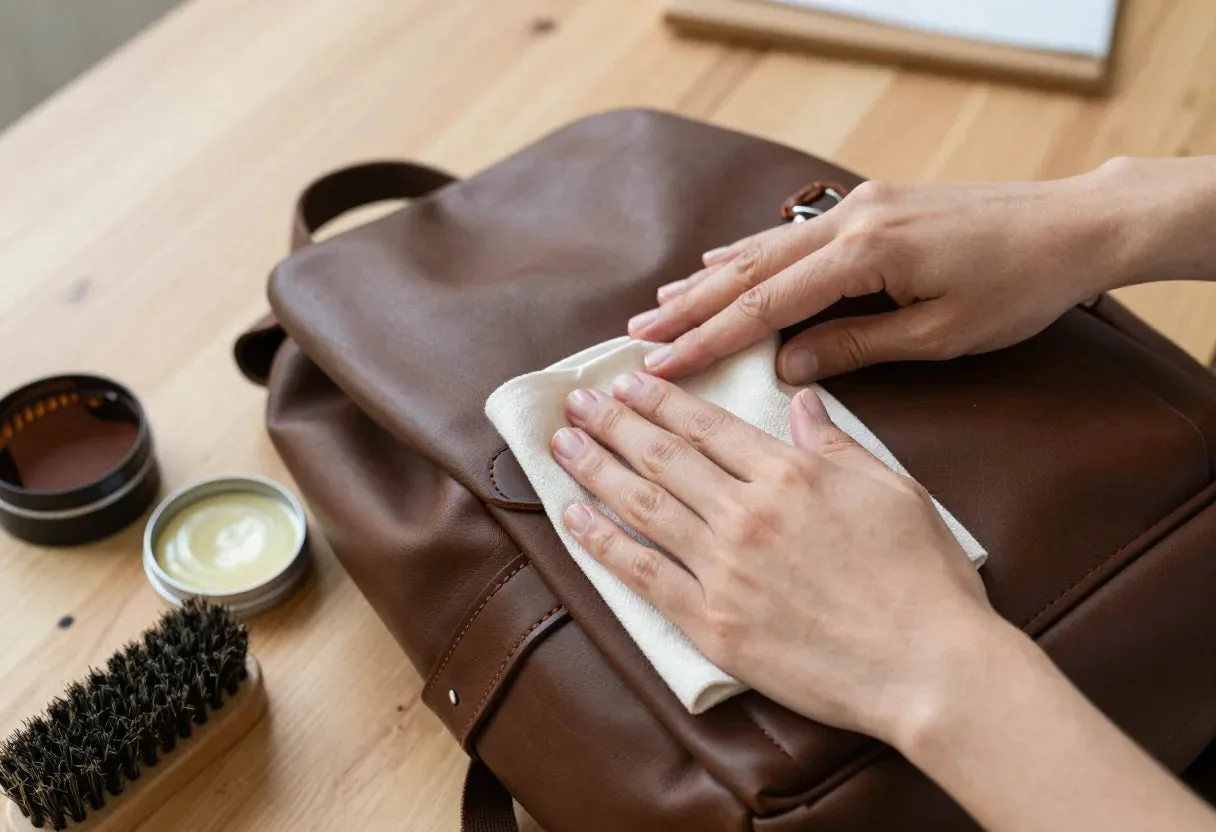
I learnt how to clean a leather bag the hard way, by killing one with a radiator. It had been caught in the rain, I was in a hurry, and I put it on the convector heater in the living room, thinking it would dry faster. The next morning the leather was as stiff as cardboard and a crack ran right across the flap. Nothing ever brought it back.
That is the kind of mistake you only make once. But I made others before I settled on a routine that works. I cleaned a bag with washing-up liquid, I rubbed olive oil into leather on the advice of a forum, and I left a bag in a plastic bag for a whole winter.
What follows are the habits I kept after all that. They take very little time, which is the only reason I really stick to them. Caring for a leather backpack is not complicated, it is just easy to get wrong.
- What really damages leather, and what does not
- What I keep at home, and what I stopped using
- The two minutes a week that change everything
- How to clean a leather bag: the deep clean, twice a year
- How to condition a leather bag: I used far too much
- How to remove stains from a leather bag
- Leather in the rain: the hour after decides everything
- Not every leather is cleaned the same way
- Storage, where I lost a bag for a silly reason
- The questions I get asked
What really damages leather, and what does not
It took me a while to understand the mechanism, and once you do, everything else makes sense. Leather is supple because it contains oils and fats. Anything that strips those fats makes it stiff, and stiff leather ends up cracking.
Where the damage comes from, in my experience:
-
Dry heat. My radiator, then. But also a car boot in summer, or a hairdryer. It is the most violent cause, and the most damaging, as it is often irreversible.
-
A lot of water. Not rain, soaking. As it dries, the water takes the fats with it. The leather comes out stiff and lighter in patches.
-
Household cleaners. Washing-up liquid degreased my bag exactly the way it degreases a frying pan. It worked very well, and that was the problem.
-
Dry rubbing. A strap that rubs every day against a rough wool coat wears the surface faster than you would think.
What does not damage it, contrary to what I believed, is use. My most worn bag is in better condition than the one that spent two years in a wardrobe. Leather does not like sitting still.
What I keep at home, and what I stopped using
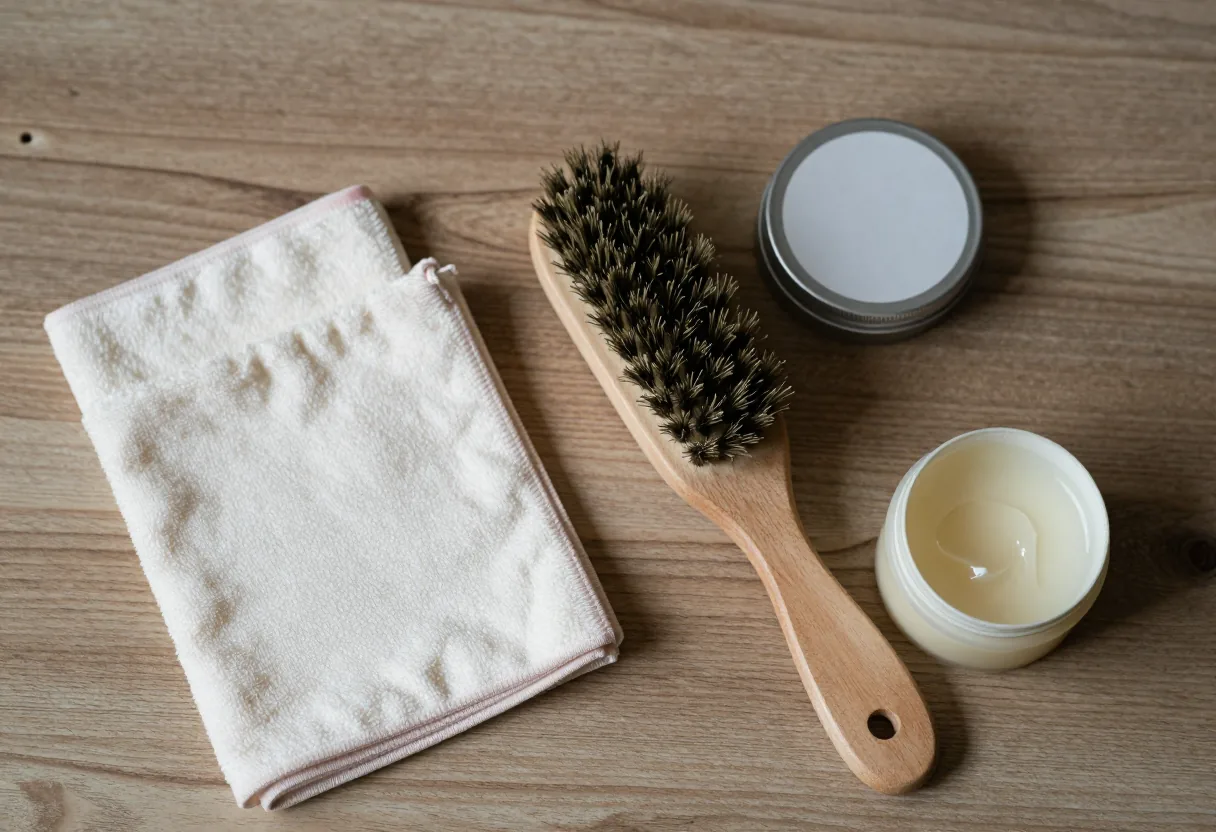
The list is short. Everything comes from a hardware shop or a cobbler, and it cost me about €30, once.
-
Two microfibre cloths, one to clean and one to buff. I keep them apart, otherwise I spread back what I have just removed.
-
A soft-bristled brush, an old horsehair shoe brush, for the seams.
-
A glycerine soap for leather. One tin lasts for years.
-
A colourless leather conditioner. For a long time I used a tinted cream, and I stopped after darkening a light bag without meaning to.
-
A waterproofing spray for leather, once a year, in October.
What I no longer use, and why: washing-up liquid (it degreases), disinfectant wipes (alcohol), neat vinegar (too acidic) and above all olive oil. That one deserves a word. It worked wonderfully for two weeks, then on my bag it turned rancid. My bag smelt odd for months and dark marks appeared where I had put the most. I never managed to get them out.
The two minutes a week that change everything
This is the step I always skipped, telling myself I would do a big clean later. It is the one that prevents the most problems.
-
I empty the bag and turn it upside down over a bin. Crumbs, sand, little stones. A grain of sand stuck in a seam acts like sandpaper every time the bag moves. I understood this when I saw the uneven wear on one of my bags.
-
I wipe it all over with a dry cloth, especially the base and the straps.
-
I brush the seams to dislodge what has built up in them.
Nothing else. No water, no product. I do it on Sunday evening while listening to something, it takes two minutes, and honestly it does more for the bag than the deep clean.
How to clean a leather bag: the deep clean, twice a year
I do it when the seasons change, because that is when I swap bags anyway and it comes to mind. The same steps work to clean a leather backpack, a handbag or a shoulder bag.
-
Empty it completely, inner pockets included, and open every zip.
-
Dust it dry, as you do every week.
-
Test the soap on a hidden area first, under the flap or on the back of a strap, and wait until it is dry before going on.
-
Dampen a cloth and wring it out until it is barely damp. This is where I went wrong for a long time. Barely damp means you can hardly feel the water when you touch it.
-
Work a pea-sized amount of leather soap into a lather on the cloth, and clean small areas at a time with light circular movements.
-
Wipe straight away with the second cloth, dry.
-
Let it dry at room temperature, away from any heat source, for at least four hours. I prefer to wait overnight.
-
Condition the leather once it is completely dry.
For the inside, I vacuum with the brush attachment. If the lining is stained, I spot clean it with a little soapy water, taking care not to wet the leather from behind. That detail cost me a water mark on a light bag.
How to condition a leather bag: I used far too much
This is my most stubborn mistake. I assumed that if a little was good, more would be better. The result was a greasy layer that did not soak in, that felt sticky, that attracted dust, and that left a mark on a beige coat.
How much: a pea-sized amount for a whole bag. On the cloth, never straight onto the leather. The layer should be barely visible.
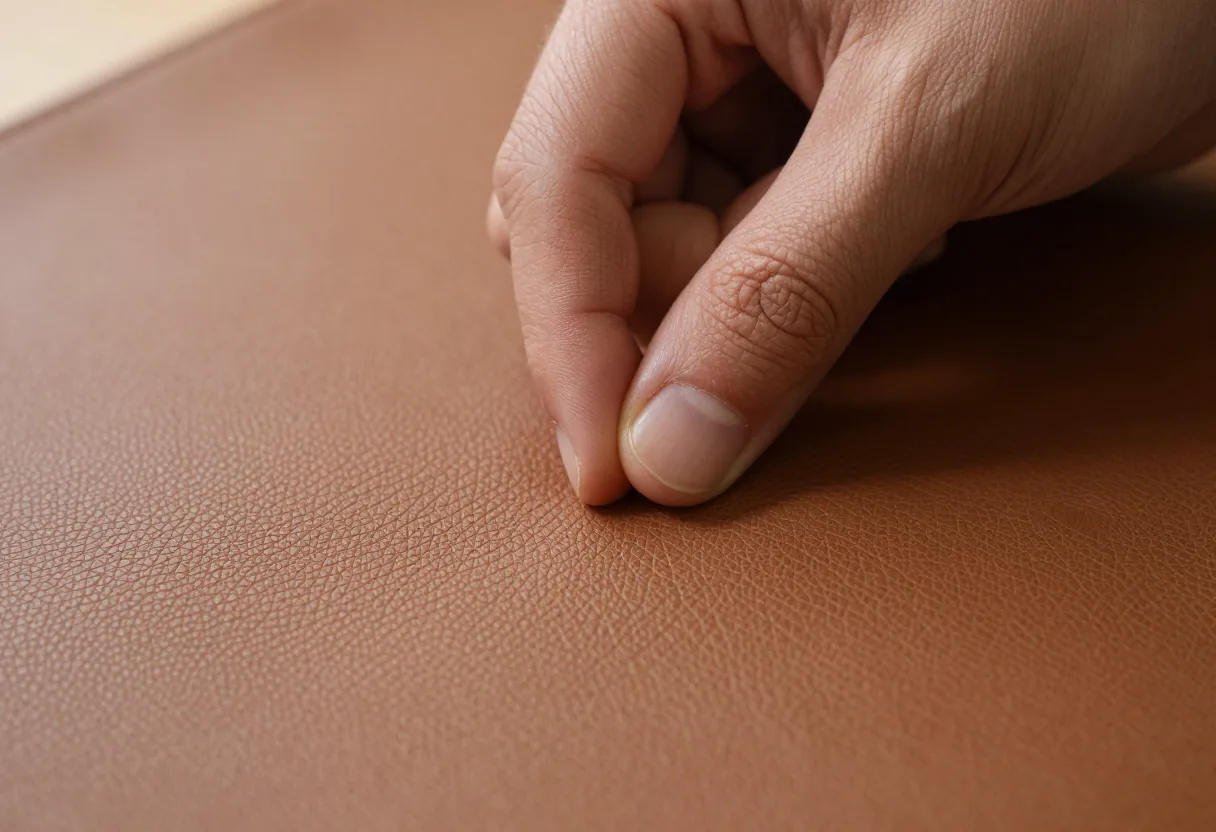
How often: twice a year for a bag worn every day, once for a bag used now and then. The test I use is simple. I pinch the leather between two fingers. If it no longer forms fine, soft wrinkles, it is thirsty.
Method:
- Test on a hidden area, under the flap, and wait an hour. Some creams darken light leather, which is how I lost the original colour of a bag.
- Apply a thin layer with circular movements.
- Leave it to soak in, it takes up to an hour.
- Buff with a dry cloth until it has a satin look.
The first time you do it properly, the result is quite striking. Leather that looked dull regains its depth within the hour.
How to remove stains from a leather bag
Water marks
It sounds wrong, yet it works. Dampen the whole area evenly, including around the mark, so that the edge disappears. Then let it dry slowly and condition it. That is how I saved a mark I thought was permanent.
Grease and oil stains
Fuller’s earth straight away, or failing that talc or cornflour. Sprinkle it on, leave it for twelve hours, and the powder absorbs the grease. Brush it off. You sometimes need two goes. Above all, do not rub it with water. That is how I turned a small stain into a big water mark.
Mud
Let the mud dry completely, then brush it off gently with a soft brush. Wipe what is left with a barely damp cloth and let the bag dry away from any heat. Rubbing wet mud only pushes it into the grain.
Ink
The worst. A cotton bud barely moistened with isopropyl alcohol, dabbed on without rubbing, can work on pigmented leather. On unprotected leather, ink soaks in within seconds and I have never been able to do anything. Test it first on a hidden spot, as on some finishes alcohol takes the colour off with the ink. If the test spot loses its colour, or the leather is unprotected, go to a cobbler.
Light or white leather
Light leather shows every mark, so wipe them as soon as you see them with a barely damp cloth, use only colourless products and always test on a hidden area first. A tinted cream is how I darkened one of my light bags for good.
Scratches
On unfinished full-grain leather, light scratches often fade on their own. Rub the area with your finger, as the warmth and natural oils of your skin are often enough. It still surprises me every time. If it persists, a matching tinted cream fades it.
Mould
The bag forgotten in a plastic bag all winter, that was it. Put on gloves and an N95 mask first. Take the bag outside, so you do not spread the spores indoors, and vacuum the marks off with the brush attachment. I then wiped mine with a cloth very lightly moistened with equal parts water and white vinegar. If the mould covers a large area, take the bag to a leather specialist. Dry it carefully and condition it. And above all, deal with the cause, which in my case was the plastic.
Leather in the rain: the hour after decides everything
After the radiator episode, I have a procedure and I stick to it.
-
Empty it straight away, pockets included.
-
Blot the surface water with a dry cloth, without rubbing.
-
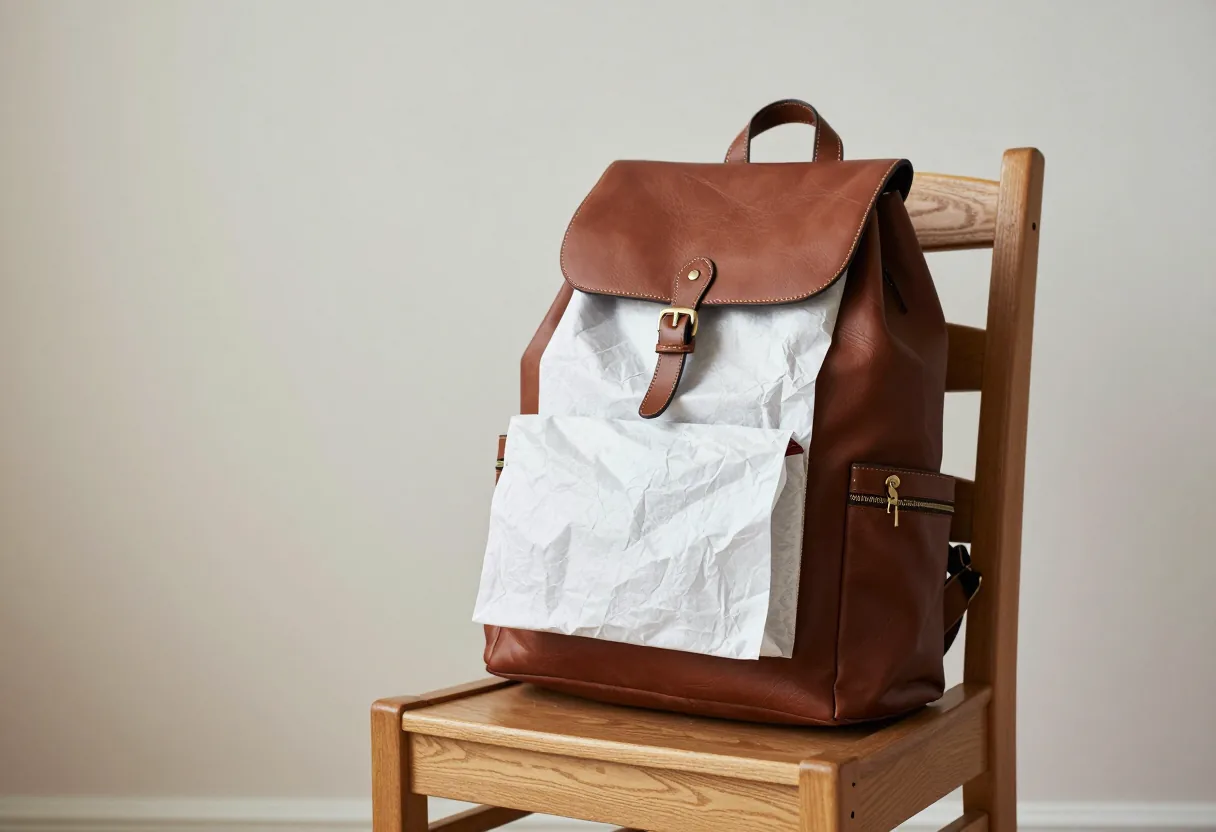
Stuff the inside with newspaper or tissue paper so the bag keeps its shape, and change the paper after two hours when it is soaked.
-
Let it dry upright, at room temperature, away from everything, for twenty-four to forty-eight hours.
-
Condition it once it is dry, because drying has taken some of the fats with it.
The whole trap is in step 4. The urge to speed things up is very strong when you need the bag the next day. That is exactly when you should take another bag. If your commute is often wet, it is worth keeping a waterproof backpack for the days when rain is forecast.
Not every leather is cleaned the same way
I learnt this by damaging suede with a cream meant for smooth leather. What works on one can ruin another.
-
Unprotected full-grain leather: it stains the most, but it responds best to care. Cream twice a year, waterproofing spray once a year, and accept the patina.
-
Pigmented or corrected-grain leather: the surface coating protects it. A damp cloth is usually enough. A light colourless cream once a year does no harm if the maker’s label allows it.
-
Nubuck and suede: never cream, never water. A nubuck brush, a special eraser, a dedicated spray. That is all. My cream left a permanent shiny patch on a pair of suede straps.
-
Oiled or waxed leather: a leather grease such as dubbin rather than a cream. It takes on a patina very quickly and repairs well. It is a very forgiving leather.
-
Faux leather and vegan leather: a damp cloth and mild soap. Leather cream does not soak in, it stays on the surface. One thing that cracks these materials is folding them again and again in the same place.
How to clean a faux leather bag
Many of our backpacks are faux leather, so this one matters. Wipe the bag with a soft cloth dampened in warm water with a drop of mild soap, then dry it straight away with a dry cloth. It needs no conditioner, as leather cream stays on the surface. Keep alcohol and heat away from it, as they can damage the coating. Store it stuffed rather than folded, because creases made again and again in the same place crack the coating.
If you are not sure which family your bag belongs to, check the material on its product page. Each of ours says whether the bag is genuine leather or faux leather.
Storage, where I lost a bag for a silly reason
The mouldy bag, then. Put away still damp in a knotted plastic bag, in a cupboard, in November. Found again in April. Three rules since then:
-
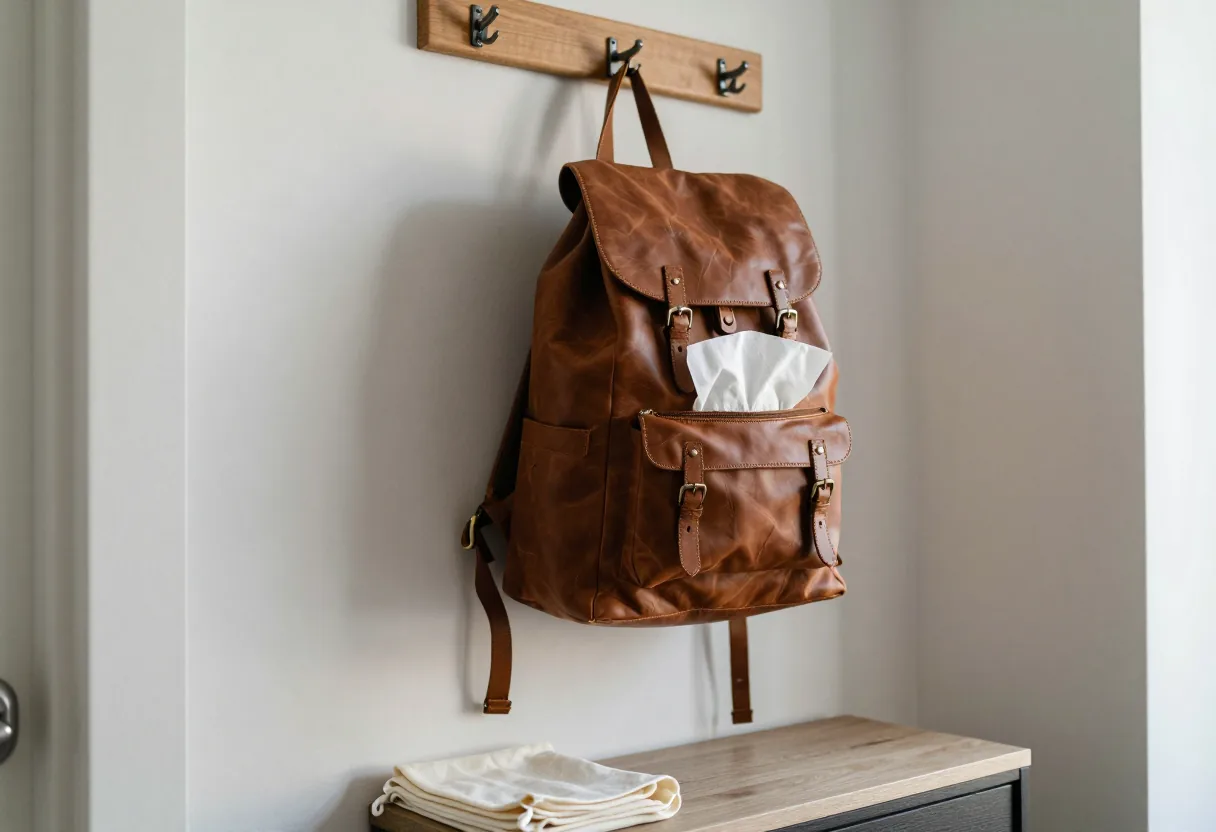
Stuff the bag with tissue paper or an old T-shirt. A bag stored folded keeps the crease for good, and I have one that proves it.
-
A cotton dust bag, never plastic. Plastic traps moisture. The dust bag that comes with a new bag is made for exactly this, it is not packaging.
-
A dry, dark place. Direct sunlight fades leather, and a damp cellar makes it go mouldy.
And I take it out once a season, air it for a few hours and check how supple the leather is. It takes five minutes and it has stopped me making the same mistake twice.
The questions I get asked
How often should you condition a leather bag?
Twice a year if you wear it every day, once otherwise. But the calendar matters less than the pinch test. If the leather no longer forms fine, soft wrinkles when you press it, it needs it, even if the last time was three months ago.
Can you put a leather backpack in the washing machine?
No, and I say it all the more firmly because I saw the result on a friend’s bag. It came out stiff, misshapen and faded, and nothing could be done. Fabric backpacks are a different story and can go in the machine with the right precautions, as I explain in how to wash a backpack.
Can you clean a leather bag with washing-up liquid?
I would not. It strips the fats that keep leather supple, which is how I ended up with a stiff, dull bag. Use a soap made for leather, on a barely damp cloth.
Cream, polish or leather grease: what is the difference?
Cream nourishes, and a colourless one is what a bag needs. Polish adds shine but nourishes little, it is made for shoes. Leather grease nourishes deeply and waterproofs, but it darkens the leather noticeably, so I keep it for oiled leather and outdoor gear.
How do you get rid of a smell inside a leather bag?
Leave the bag open in the fresh air, in the shade, for forty-eight hours. If the smell persists, put a small open container of bicarbonate of soda or dry coffee grounds inside for two days, without touching the leather. Never use an air freshener spray, as it adds a smell instead of removing one.
Can you use baby wipes on a leather bag?
Several care guides advise against them, as their chemicals and moisturisers can dry out or damage the finish. A barely damp cloth does the same job without the risk.
Can a leather backpack be repaired?
Yes, and that is what I should have done with my first bag instead of throwing it away. A cobbler can redo a seam, replace a zip or change a buckle for much less than a new bag. Only deep cracks in the leather are lost for good, and that is exactly what regular care prevents.
What I do today, in short
A dry cloth on Sunday evening. A gentle clean and a cream in April and October. A slow, cool drying every time a bag gets wet. It comes down to three habits, and I have had no nasty surprises since.
The rest is mostly what not to do, and I have tried almost all of it: heat, detergent, cooking oil, the plastic bag. Each of those mistakes cost me something, and none of them was necessary.
What surprised me most, in the end, is that well-cared-for leather does not just last. It gets more beautiful. I do not know any other material you can say that about.