
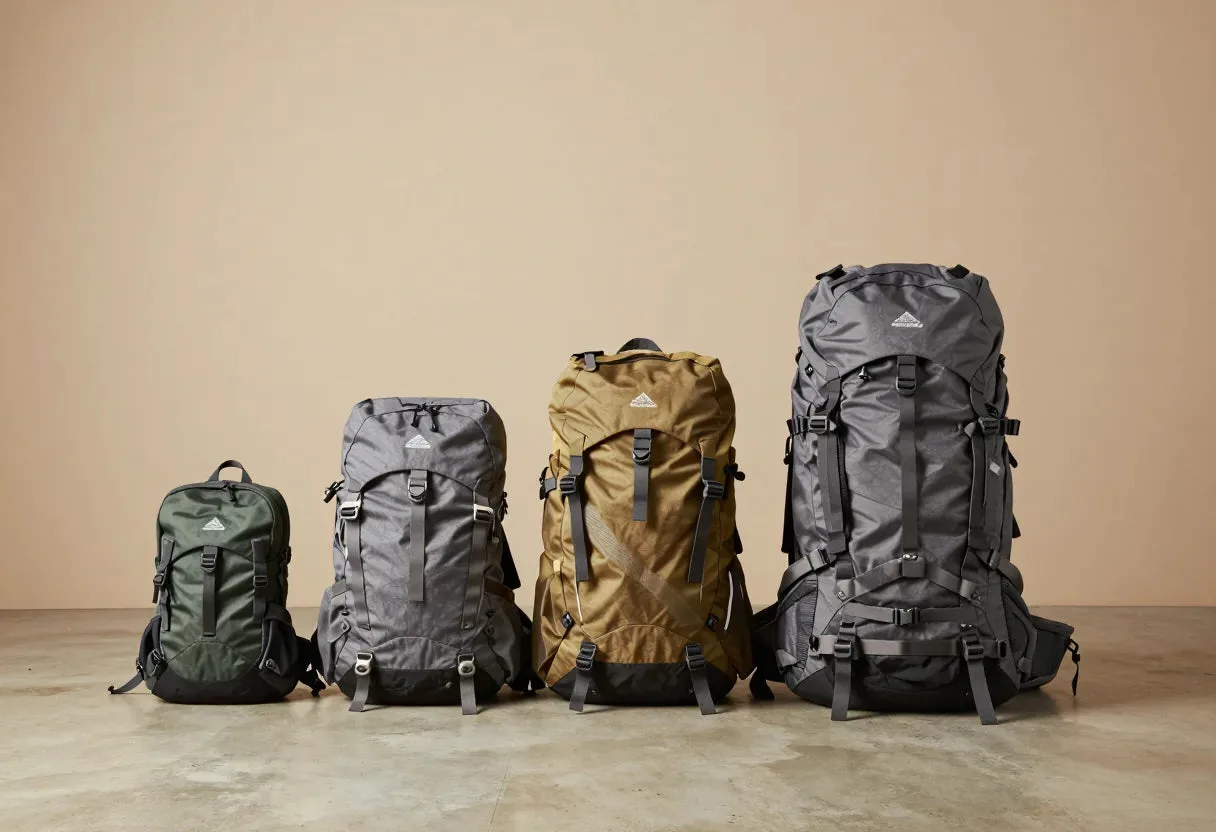
What size backpack do I need? The first time I answered that question, I got it wrong, and I spent three weeks in South-East Asia with a 70-litre pack. It was my first big trip, and I had reasoned that bigger meant more freedom. In reality, I carried fifteen kilos for three weeks, of which I used perhaps half, and I spent my time digging for things at the bottom.
On the next trip, I took a 45-litre pack. I did not miss anything I had left behind, and I walked much better. That is when I understood something simple. The space you have always ends up filled. The bag does not adapt to your things, your things adapt to the bag.
So here are my benchmarks for backpack sizes in litres, use by use, drawn mostly from my own bad calculations.
- Why the size of your backpack matters
- Backpack sizes in litres and what each one is for
- What size backpack do I need for each use?
- What to check beyond the litres
- My backpack size chart by capacity
- Practical tips for filling your backpack
- The questions I get asked
Why the size of your backpack matters
Carrying comfort comes first
A bag that is too big is not just bulky. It changes where the weight sits. On my 70 litres, the contents floated and slumped downwards and backwards with every step, and I spent my time tightening the compression straps. A bag that is eighty per cent full carries much better than a big bag that is half empty.
Matching the volume to your body
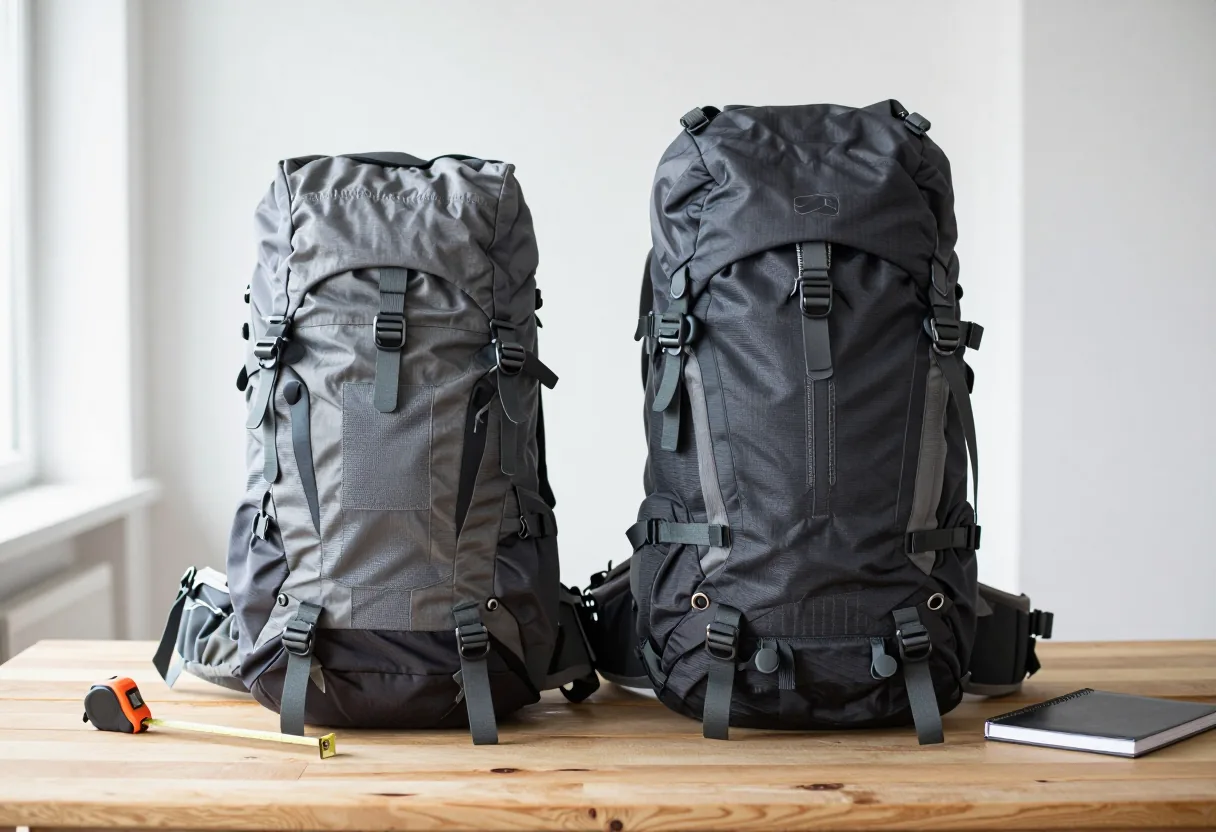
This point had escaped me. The capacity in litres says nothing about the length of the back. A 50-litre pack can come in several back lengths, and that length decides whether the hip belt lands on your hips or on your ribs. I am 1.65 m tall, and for a long time I carried bags whose belt sat too high, telling myself it was normal.
How to measure your back length
Packs are sized on your torso length, not on your height. With someone to help you, measure from the bony bump at the base of your neck, where it meets your shoulders, down to the point on your spine level with the top of your hip bones. Then compare that figure with the brand’s size chart. Some larger packs have an adjustable back system, so you can set this length yourself, and some brands also give a range of hip sizes for the belt.
What a bag that is too heavy costs you
Over my three weeks in Asia, I carried fifteen kilos. The real cost was not the tiredness in the evening. It was that I chose my routes around the bag. I took taxis where I would have walked. A bag that is too big makes the trip smaller.
Backpack sizes in litres and what each one is for
Small backpacks, 10 to 30 litres
The city, the office, a day out. At 20 litres you can fit a laptop, a charger, a water bottle and lunch, which covers a normal day. Below 15 litres with a laptop, the laptop takes up everything. I have tried it.
Medium backpacks, 30 to 50 litres
My favourite size, by far. Two to four days staying in mountain huts, or a light trip of several weeks if you are happy to wash your clothes along the way. It is also the upper limit of what you can still carry comfortably for a whole day.
Large backpacks, 50 to 80 litres
Full self-sufficiency, with a tent, a stove and food for several days. It is the size you need when you really are going self-supported, and the one not to take when you are not. My 70 litres belonged to this category, and I had bought it for a trip staying in hostels.
Over 80 litres
Expeditions, winter, technical kit. Unless you have a very specific need, it is a size that concerns almost nobody, and its empty weight is already considerable.
Why two 35-litre backpacks do not always hold the same
Brands do not all measure litres the same way. Some count only the main compartment, others include every pocket, side and hip belt pockets among them, so two packs sold as 35 litres can hold different amounts. The litres also say nothing about shape. A pack with a generous stated volume can still be too short for a laptop, which is why the dimensions in centimetres matter as much as the capacity.
What size backpack do I need for each use?
For a day hike
20 to 30 litres. Water, snacks, a warm layer, a rain jacket and a first aid kit. I have seen a lot of people set off for the day with a half-empty 40 litres, and the bag sags out of shape and sways with every step.
For a multi-day trek
40 to 50 litres if you sleep in huts, 55 to 65 litres self-supported with a tent. The difference comes almost entirely from the tent, the sleeping mat and the food. In winter or in cold weather, allow a little more, because the extra layers and a warmer sleeping bag take up room.
For backpacking travel
40 to 50 litres, and I say so with the conviction of someone who has tried 70. A 45-litre pack often goes in the cabin on long-haul flights and saves you the wait at baggage reclaim. What I gained by going smaller far outweighs what I lost. See also our travel backpack collection.
For the city
15 to 25 litres. Above all, check that the laptop compartment is padded and raised off the bottom, and measure your laptop in centimetres rather than trusting the stated inches. It is the most common buying mistake. The models in our laptop backpack collection cover this size. For the office, see also how to choose a work backpack for women.
What to check beyond the litres
Shoulder straps, other straps and the hip belt
Above 30 litres, the hip belt is not an accessory. It is the part that should carry 60 to 70% of the weight. On my first big pack, it was thin and unpadded, and everything fell back onto my shoulders. It took me a long time to understand that the problem was not the weight but the belt.
When you try a pack on, the belt should sit on the top of your hip bones, not around your waist, and the shoulder straps should hold the pack close without digging in. On larger packs, the short load lifter straps at the top of the shoulder straps pull the top of the bag in towards you, so it does not pull back on your neck and shoulders.
Waterproofing and materials
Nylon resists abrasion better than polyester of the same density. Few bags are truly waterproof, and a rain cover is not enough, because water runs down your back and gets in at the top. Since one memorable stormy evening, I add dry bags inside for my sleeping bag and dry clothes. Our waterproof backpacks collection has the models designed for that.
Access and storage
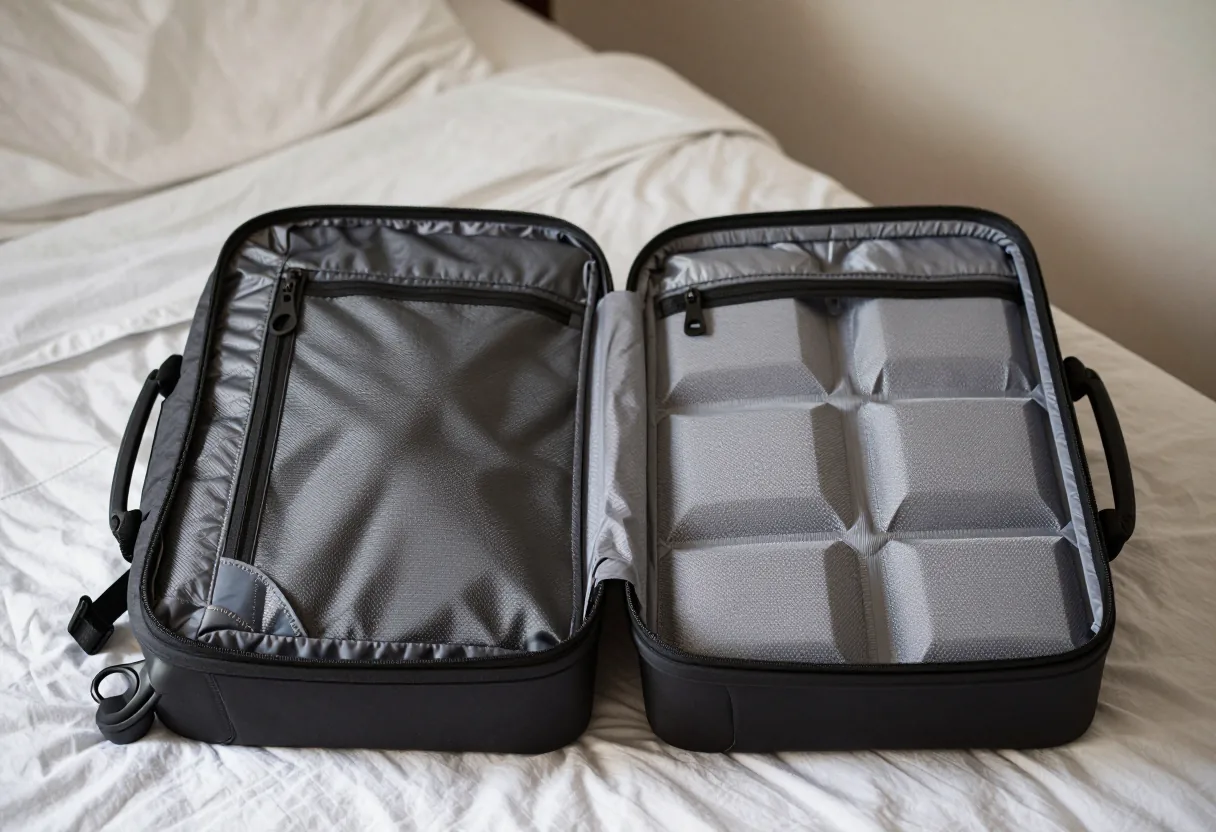
It is the criterion I rank highest today. A bag that only opens from the top makes you empty everything to reach the bottom. A suitcase-style opening changes everything when you travel, and I would not set off without one again. Our cabin backpack that opens like a suitcase is built on this principle.
Body shape
Women’s models have a shorter back and curved shoulder straps, narrower at the base. It is not cosmetic. On the standard version of the same bag, the straps kept sliding towards the outside of my shoulders. Our women’s backpacks collection includes these adjustments.
My backpack size chart by capacity
| Capacity | Use | Empty weight | My note |
|---|---|---|---|
| 10 to 20 L | City, school, short outing | 400 to 700 g | I carry a laptop, a water bottle and lunch |
| 20 to 30 L | Office, day hike | 600 g to 1.1 kg | A warm layer and a rain jacket on top of that |
| 30 to 45 L | Weekend, light travel, mountain huts | 1 to 1.6 kg | The most versatile size, the one I would recommend if you could only have one |
| 45 to 60 L | Multi-day trek, long trip | 1.5 to 2.3 kg | The hip belt becomes essential |
| 60 L and more | Full self-sufficiency | 2 kg and more | That is empty, before you have put anything in it |
One figure I now check every time, and that I used to ignore completely, is the empty weight. Two 50-litre bags can differ by 800 grams, the weight of a whole water bottle.
Practical tips for filling your backpack
Spreading the weight
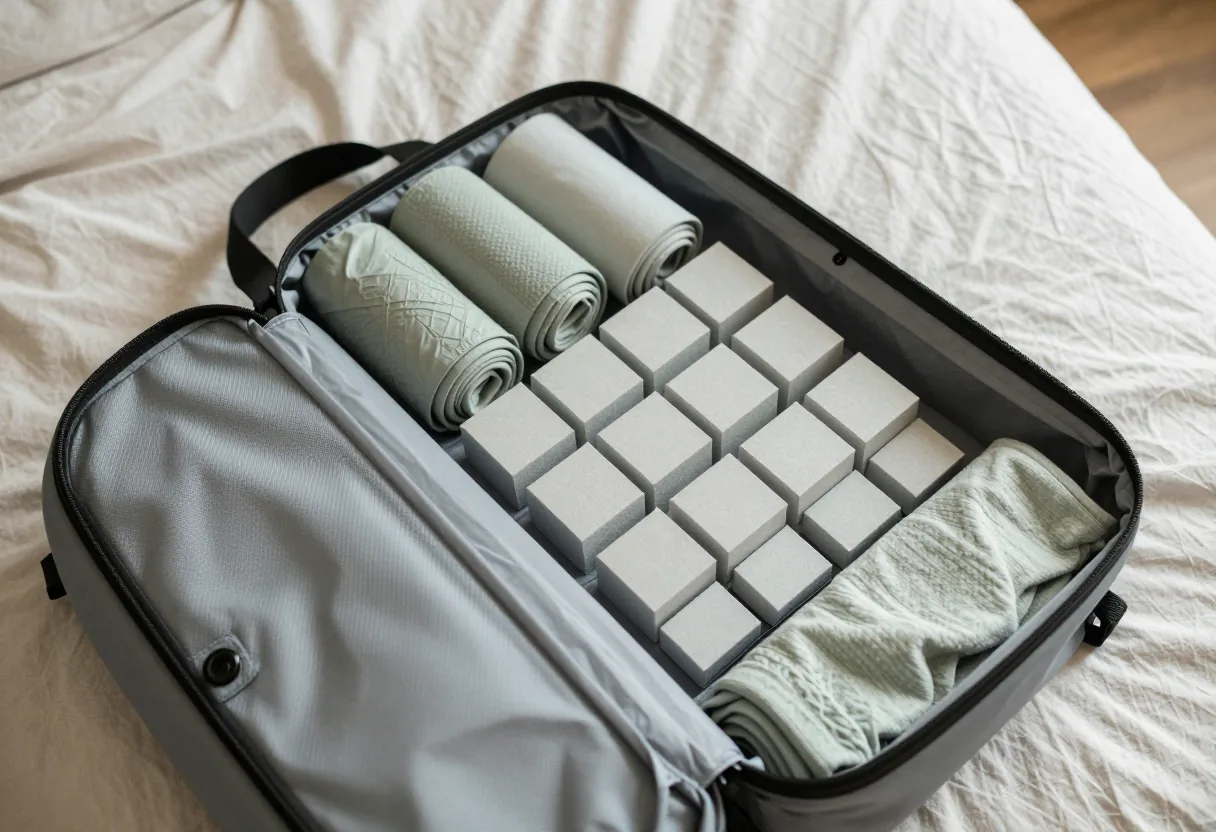
Heavy items in the middle, against your back, at shoulder blade height. Bulky, light items at the bottom. Quick access at the top. I used to put heavy things at the bottom because it seemed logical, and that is exactly the opposite of what you should do. I go through the packing order in my guide on how to pack a hiking backpack.
Roll rather than fold
Tightly rolled clothes take up much less room and crease less. Packing cubes have saved me a lot of time when travelling. Instead of rummaging, I take out the right cube.
Using the compression straps
They are not there to crush the bag, but to hold the contents tight against your back. A compressed bag carries like a smaller one. That is what I was doing wrong on my 70 litres, and it is why it swayed.
Travelling light, in practice
- One change of clothes, not three. You wash along the way.
- Repack food out of its original packaging.
- Fill your water bottle along the way rather than setting off with two litres. A litre of water weighs a kilo.
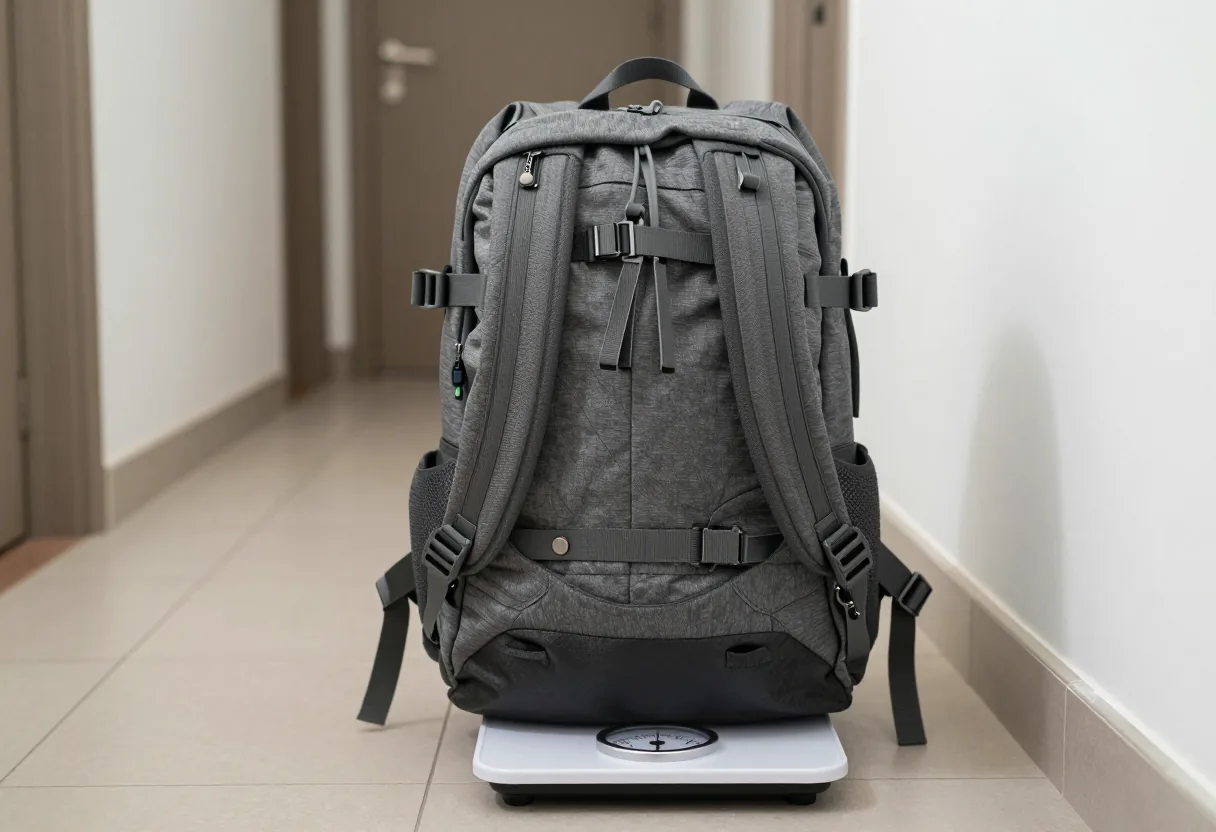
- Weigh the bag before you leave. It was by putting mine on the scales that I discovered my fifteen kilos.
For uses where the volume changes from one day to the next, the multi-purpose expandable travel backpack, which expands from 23 to 31 cm deep, saves you having to choose between two sizes.
The questions I get asked
Which backpack for the plane, in the cabin or in the hold?
In the cabin, stay under about 40 x 20 x 55 cm, which is 35 to 45 litres depending on the shape. Check your airline’s dimensions, because they vary a lot on low-cost airlines. Our guide to cabin bag size by airline gives each UK airline’s limits as stated by the airline. In the hold, strap down everything that dangles, otherwise the straps get caught in the conveyor belts. See our cabin backpacks.
How big is a 30L backpack?
Big enough for the office or a day hike, the 20 to 30 litre row of my chart, and for a weekend away if you pack light. To give you an idea, our ergonomic 40x30x20 cabin backpack holds 30 litres in 40 x 30 x 20 cm and takes a laptop up to 17 inches.
What size hiking backpack for women?
The same litres as for everyone, but a shorter back length and curved shoulder straps. That setting is what matters, not the volume. A 1.60 m walker will be better off with a 45-litre pack with a short back than with a 40-litre one with a standard back.
To compare volumes and carrying systems, have a look at our hiking backpacks.
How much weight can I carry at most?
Around 20% of your body weight for hiking. For travel, I aim for 10 to 12 kg all in, because you carry the bag up station stairs and not only along a path. My fifteen kilos in Asia were well above what I can carry comfortably.
Backpack or suitcase for travelling?
The backpack wins as soon as there are stairs, cobbles, public transport or walking. The suitcase wins for a stay in a single hotel with a taxi transfer. I have both, and I take the backpack nine times out of ten.
What size backpack do I need? What my 70 litres taught me
Take the volume of your real needs, not of your imagined ones. A well-filled 45 litres will take you further than a half-full 70 litres, literally.
And weigh your bag before you leave. It is the most useful habit of all, and nobody does it.
Further reading
- See our backpacks for hand luggage
- The multi-purpose expandable travel and hiking backpack
- Our backpacks for women