
On the second day of a trek in the Mercantour, in the southern French Alps, I had to empty everything out at the side of the path to find my waterproof jacket, and that was the day I started to learn how to pack a hiking backpack. The jacket was at the very bottom, under the sleeping bag. It had already been raining for ten minutes, my things were spread out on a wet rock, and two people walked past me, staring.
That day I understood that packing a bag is not about being tidy. It is about logic. What you use while walking goes at the top, what you only open at camp goes at the bottom, and the weight goes where your back can carry it.
Here is the method I have used ever since, zone by zone, with the mistakes that led me to it. It is my way of packing a rucksack for the hills, not a truth set in stone, but it has saved me from repeating the scene on the wet rock.
- Why it matters how you pack a hiking backpack
- Lay out your kit before you fill the rucksack
- How to pack a hiking backpack, zone by zone
- How to lighten your rucksack without forgetting anything
- The packing mistakes I made
- How to pack a rucksack: the questions I get asked
Why it matters how you pack a hiking backpack
I thought it was the perfectionism of seasoned walkers. I was wrong, and your body makes that clear quite quickly.
Comfort and balance
Carry the same bag, with exactly the same contents, twice in a row with a different packing order, and the difference is astonishing. When the heavy load sits too low or too far from your back, the bag pulls backwards and you make up for it by leaning forwards. After three hours, your lower back starts to complain.
Easy access to the essentials
This is my Mercantour episode. The waterproof jacket, the water bottle, the first aid kit and the snack bars must be reachable without putting the bag down. Anything that forces you to stop and unpack ends up not being used at all. You would rather be cold than unpack everything.
Preventing injuries
A badly balanced bag gets held up by your shoulders, and shoulders are not made for that. The hip belt should carry most of the weight. If your shoulder straps are cutting into you after an hour, the bag is not the problem. The adjustment or the weight distribution is.
Lay out your kit before you fill the rucksack
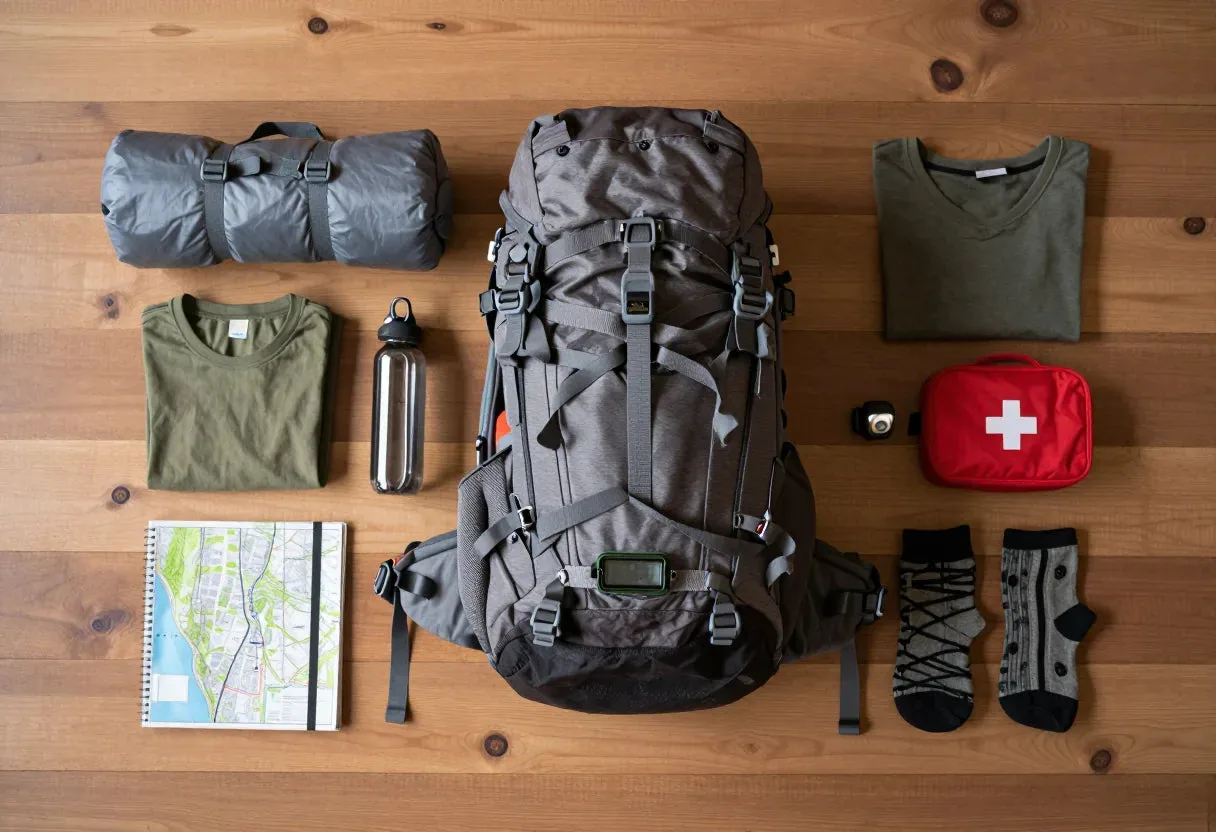
I never fill the bag straight away any more. I lay everything out on the floor first. It takes ten minutes, and it has made me leave a lot of useless things at home.
My basic list
- Sleeping: sleeping bag, sleeping mat, and the tent if you are taking one.
- Clothes: one change of clothes, a warm layer, a waterproof jacket. Not three T-shirts “just in case”, I stopped doing that.
- Water and food: the water bottle or hydration bladder, the meals, snack bars within reach.
- Safety: first aid kit, head torch, foil survival blanket, power bank.
- Navigation: paper map and compass, even with a phone. Mine ran out of battery one foggy day.
Match it to the length and type of trip
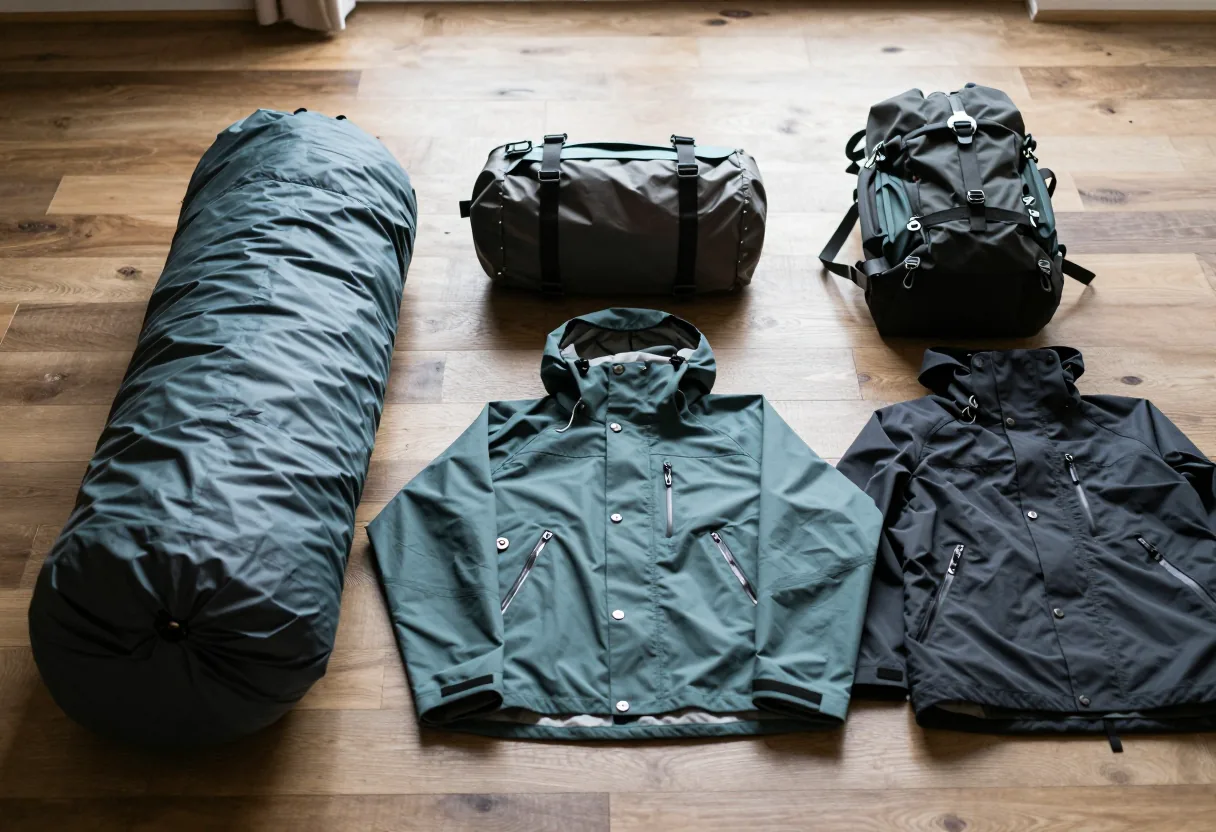
A day walk fits in 20 to 30 litres. Two or three days staying in mountain huts, 30 to 45 litres. A self-supported trek with a tent, 50 to 65 litres. Beyond that, I have found that the space available always ends up being filled, even when you do not need it. It is a trap I still fall into. The breakdown of how many litres to choose for each use is in my guide to what size backpack you need, and the capacities on offer are in our hiking backpacks.
How to pack a hiking backpack, zone by zone
The principle that governs everything is simple. The heavy load must sit in the middle of your back, against your shoulder blades. Not at the bottom, not at the top, not far from your back. Everything else follows from that.
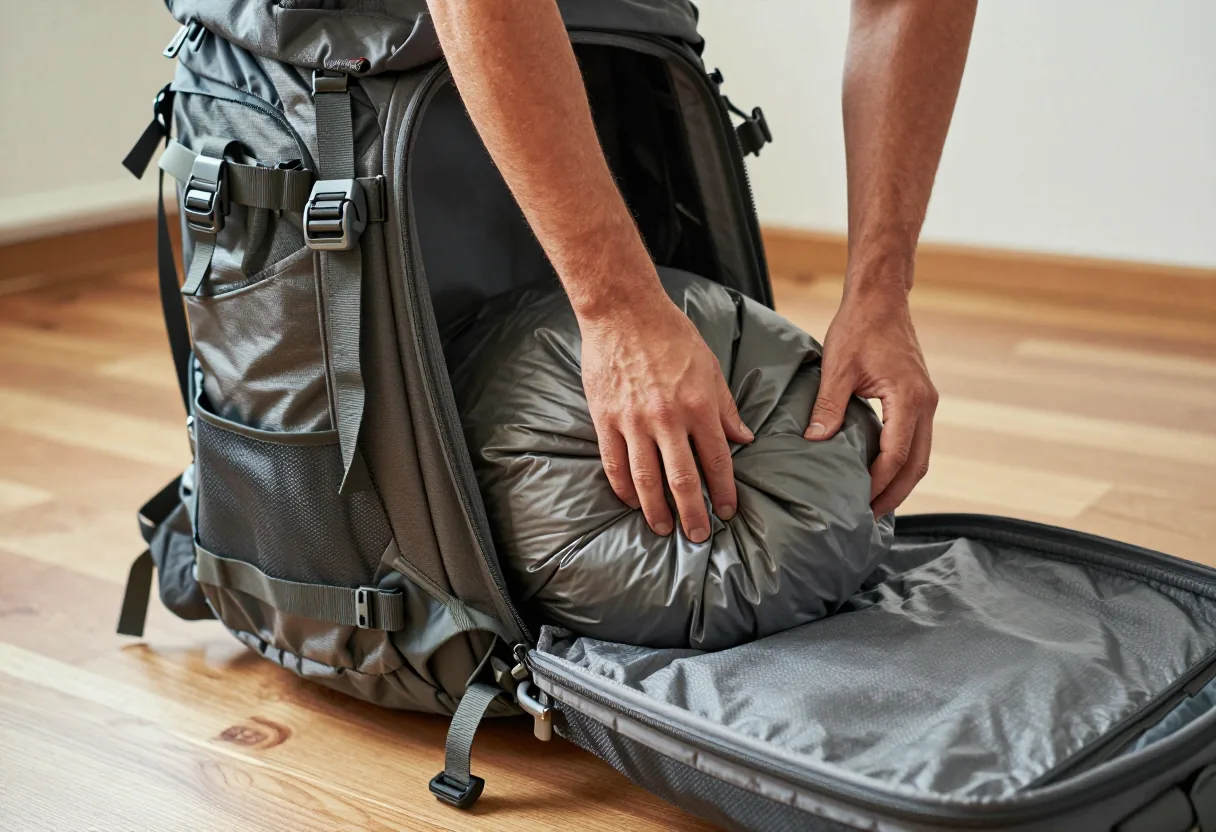
At the bottom of the bag, the sleeping zone
The sleeping bag, the sleeping mat, the clothes you sleep in. In other words the bulky but light things you do not open during the day. They make a soft base that gives the bag its shape. Many rucksacks have a separate lower compartment designed for exactly that.
In the middle, against your back, the densest zone
Food, stove, spare water, everything that weighs. As close to your back as possible, at shoulder blade height. It is the adjustment that changed my comfort the most, and the one I got most wrong. I used to put heavy things at the bottom, because it seemed logical to me.
If you carry a hydration bladder, it belongs here too, in its sleeve right against your back. If you carry stove fuel, screw the cap on tightly, keep the bottle or canister upright and wedge it low in this zone, below and apart from your food, so a leak cannot reach your meals.
At the top, quick access
Waterproof jacket, warm layer, first aid kit, gloves. Everything I need in under ten seconds without putting the bag down. Since the Mercantour, my waterproof jacket never leaves the top of the bag, whatever the forecast says.
Side pockets and outer compartments
Water bottle on one side, walking poles or umbrella on the other. One thing worth knowing, which I discovered after walking lopsided for two hours, is that you should never load just one side. A full one-litre bottle on one side really does throw the load off balance.
Hip belt and shoulder straps
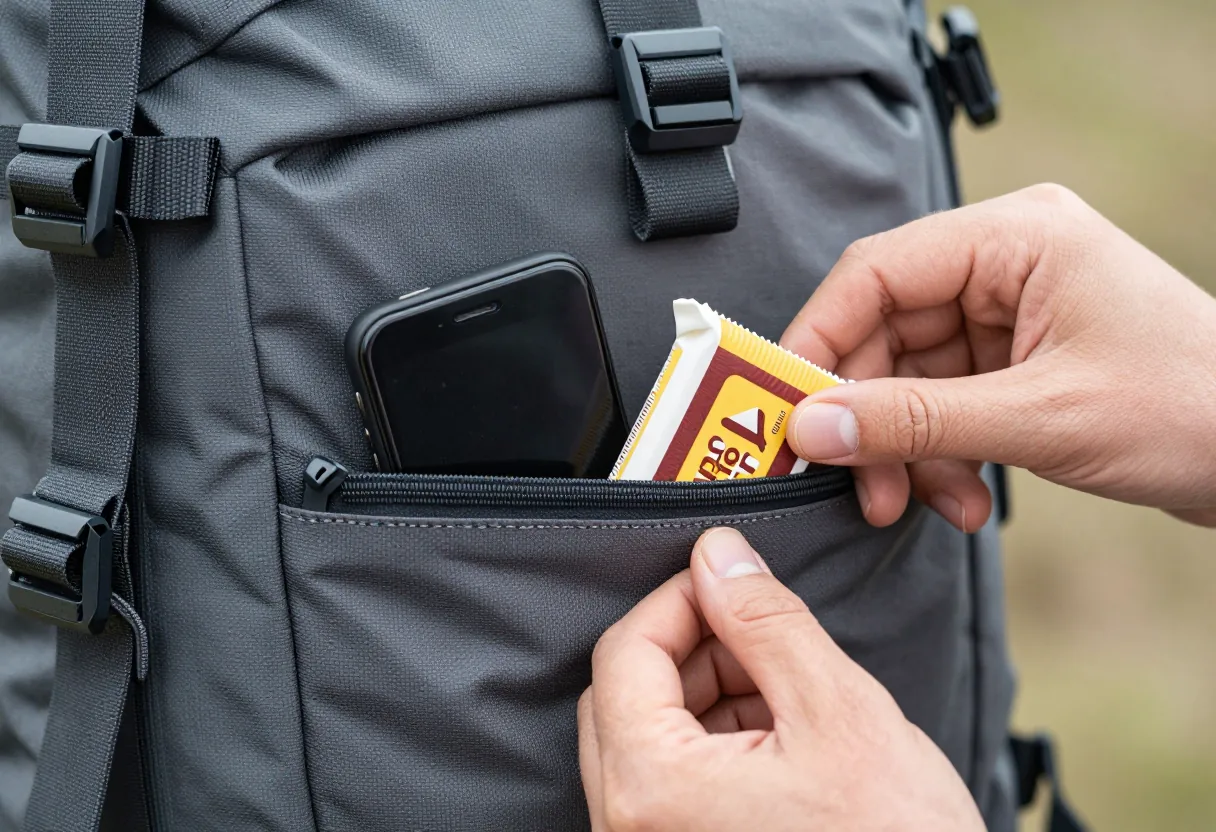
The hip belt pockets are the most practical place on the bag and the most underused. Phone, snack bars, lip balm, map. These are the things you reach for twenty times a day, and having them to hand without lifting your arms really makes a difference to comfort.
Fill the gaps, then tighten the compression straps
Once the three zones are in, push soft things such as socks, base layers and a spare fleece into the empty spaces around firmer kit, so nothing shifts as you walk. A few dry bags or packing cubes for the small items make them quicker to find. Then pull every compression strap tight, which keeps the load close to your back and stops it from moving.
Outside the rucksack, only what has to be there
The loops and straps on the outside are for things with a clear reason to be there, such as walking poles or a sleeping mat, strapped down tightly. Anything that dangles snags on branches and pulls you off balance, and kit that can get wet or break is safer inside.
Put it on, adjust it, and take a test walk
Before leaving, adjust the hip belt, shoulder straps and chest strap so that the hip belt takes most of the load and the shoulder straps only steady it. Then walk around with the loaded bag at home or round the block. It is the moment to move anything that pokes or pulls you to one side.
How to lighten your rucksack without forgetting anything
I weighed my bag for the first time after a trip on which I had suffered. Fourteen kilos for two days. It was absurd and I had not even realised.
The weight I aim for now
The common rule is to stay under 20% of your body weight, a little more for trained walkers. For me, that comes to around 12 kg. The difference between 12 and 14 kg is far more noticeable than those two kilos would suggest, especially uphill.
Share the load rather than carry it all
If you are walking as a group, pool your kit. One tent, one stove, one complete first aid kit. There were three of us with three identical first aid kits on one trek, and nobody had thought about it before the third day.
What I stopped taking
- Duplicate spare clothes. One emergency change is enough, and you wash the rest at the hut.
- Original packaging. I decant food into bags, which saves several hundred grams.
- The big camera, which I never took out more than twice per trip.
- Full water bottles when there is a spring or a hut halfway. One litre is one kilo.
For trips where the volume you need changes a lot from one day to the next, the multipurpose expandable travel backpack lets you adjust its capacity rather than lug empty space around.
The packing mistakes I made
The weight in the wrong place
The most common one, and mine for years. Heavy things right at the bottom of the bag. The result is a bag that pulls downwards and backwards, and that you hold up with your back without noticing.
A rucksack that is too heavy
Fourteen kilos for two days, as I said. The real cost is not the tiredness at the time. It is that I walked badly, that I looked at my feet instead of the view, and that I ended up not wanting to set off again.
What I still sometimes forget
The head torch, the foil survival blanket, the power bank. I take a photo of my kit laid out before I leave, and I look at it while I repack the bag. It is a silly trick, but it works better than a written list I never reread.
How to pack a rucksack: the questions I get asked
What is the ideal weight for a hiking rucksack?
Around 20% of your body weight, bag included. For a day walk, you can easily get below 15%. What matters as much as the figure is how the weight is distributed. Twelve kilos well placed carry better than ten kilos badly placed, and I have checked that several times.
What should I pack in my rucksack for a day hike?
A 20 to 30 litre bag is enough. Inside go water, snacks, a waterproof jacket, a warm layer, a first aid kit, a head torch, a map and compass, and a charged phone, with gloves or a hat depending on the weather. The waterproof, the water and the snacks go where you can reach them without taking the bag off, as in the zones above.
What is the difference between a hiking rucksack and a travel backpack?
A hiking rucksack opens from the top and carries the weight on your hips with a frame and a padded hip belt. A travel backpack opens like a suitcase, which makes it much easier to find your things, but it is designed to be carried over short distances. The models in our travel backpack collection are made for that use.
Can you take a trekking rucksack on a plane?
As hold luggage, no problem. I always strap down anything that hangs loose, otherwise the straps get caught in the baggage belts. As hand luggage, you need to stay under roughly 40 x 20 x 55 cm, which rules out most bags over 40 litres.
If your sleeping bag has to stay on the outside, I also explain how to attach a sleeping bag to a backpack and check that it is secure before you set off.
Do you need a rain cover?
Yes, and I add dry bags inside for the sleeping bag and the dry clothes. A cover alone lets through the water that runs down your back, which I found out with a soaked sleeping bag one stormy evening. A rucksack liner around the whole contents of the rucksack does the same job as the dry bags in one go.
What the Mercantour taught me about how to pack a hiking backpack
The heavy things in the middle, against your back. The bulky, light things at the bottom. What you use while walking, at the top and in the hip belt pockets. Three sentences, and they solve 90% of the problem.
The rest is about accepting that you cannot take everything. That is the hard part, and it is the one where I am making the slowest progress.
Our backpacks to take you further
- See all our hiking backpacks and trekking rucksacks
- The multipurpose expandable travel and hiking backpack
- Our travel backpacks