
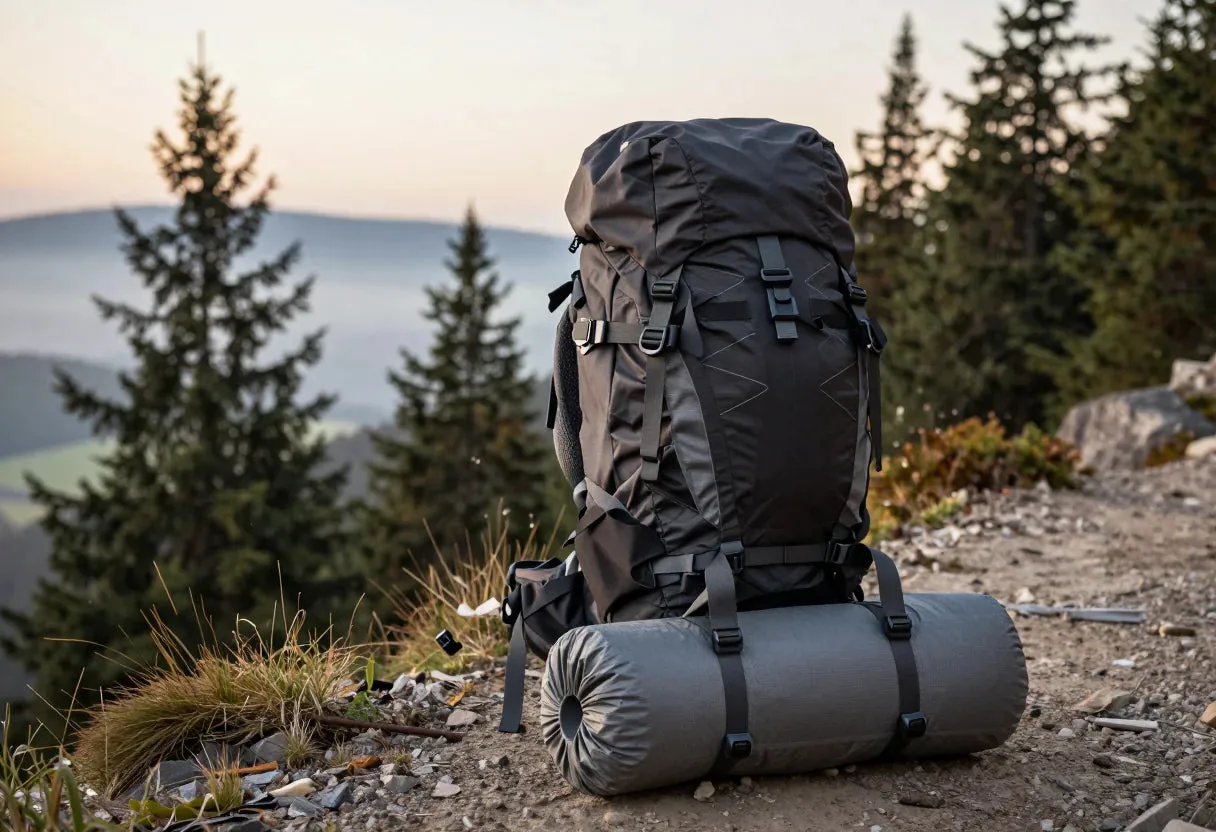
My sleeping bag came loose in the middle of a descent in the Écrins, in the French Alps, which is a hard way to learn how to attach a sleeping bag to a backpack. I had strapped it under the pack with the two buckles provided, but without threading the strap through the anchor points. It rolled some thirty metres down the slope and stopped against a boulder. It was unharmed, and so was I, but it took me twenty minutes to go and fetch it.
Since then I strap it differently, and above all I choose between outside and inside depending on the trip, which I never used to do. The real question is not only how to attach it, but also whether to attach it at all.
Here are the three methods I use to attach a sleeping bag to a backpack, what each one is worth, and the case where I do not use any of them.
- What you need before you attach a sleeping bag to a backpack
- How to attach a sleeping bag to a backpack: 3 outside methods
- The alternative: packing your sleeping bag inside the rucksack
- What I learnt about balancing the pack
- How to attach a sleeping bag securely: what to remember
- Sleeping bag and backpack questions
What you need before you attach a sleeping bag to a backpack
Your backpack and its straps
Almost every pack over 40 litres has two straps under the bottom compartment, designed for exactly this. The detail I had missed in the Écrins is that they must go through the anchor loops sewn onto the pack, not simply around the sleeping bag. Without an anchor, the strap slides under the load and the sleeping bag ends up working its way out.
Check the plastic buckles too. A cracked buckle snaps clean in cold weather, which is precisely when you are carrying a sleeping bag.
The compression sack, the thing that changes everything
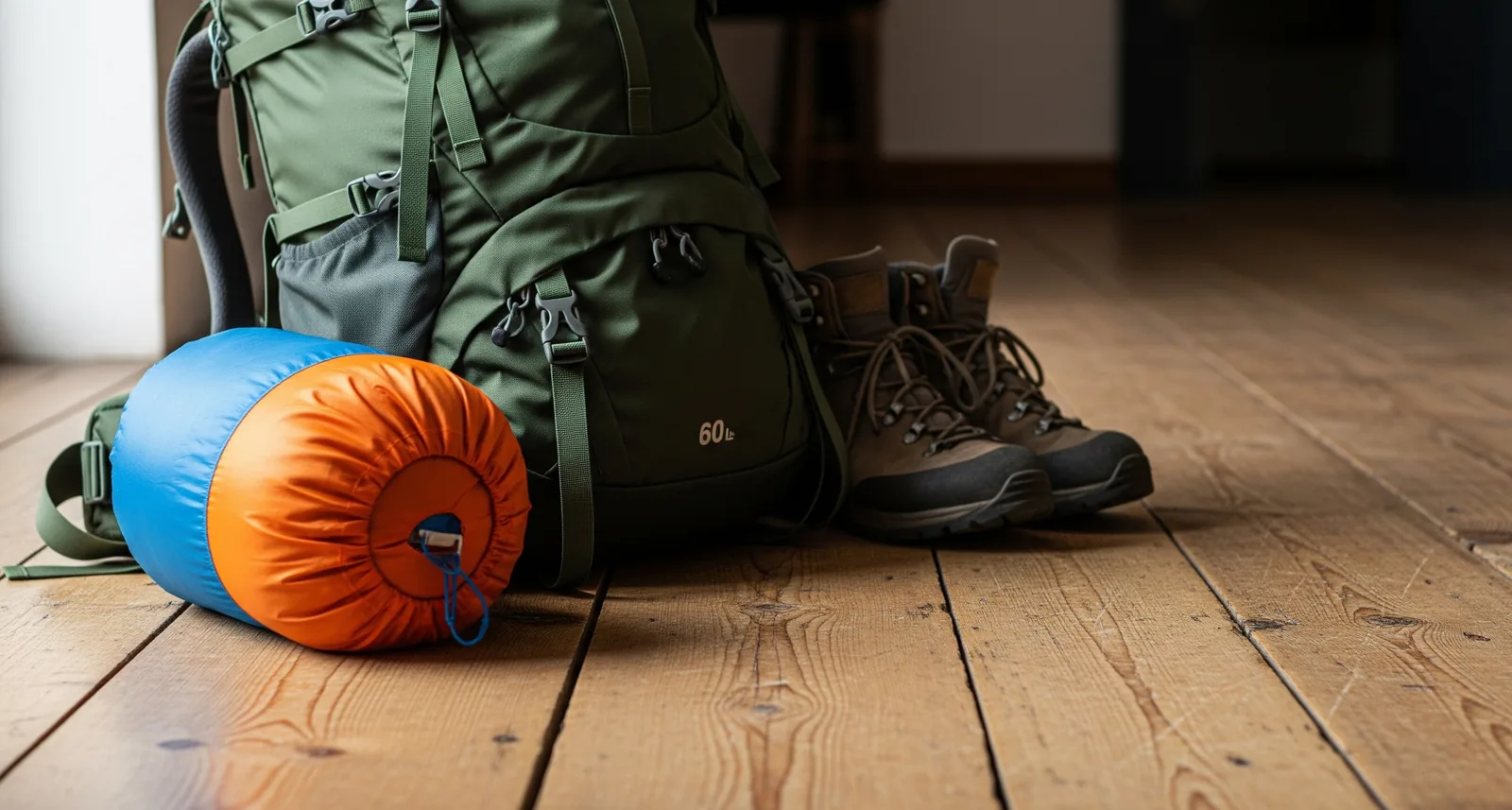
It is the purchase that has served me best, for a ridiculously small price. A compression sack cuts the volume of a sleeping bag by half, sometimes more. A sleeping bag that has gone from the size of a football to the size of a melon behaves completely differently on the pack.
Two things I learnt the hard way. First, never store a sleeping bag compressed at home, because the fill loses its loft for good. Mine was noticeably less warm after a winter stored compressed. Second, a waterproof compression sack is better than a plain one, because a wet sleeping bag no longer keeps you warm, and that is a real problem in the mountains.
How to attach a sleeping bag to a backpack: 3 outside methods
Option 1: under the pack, at the bottom compartment
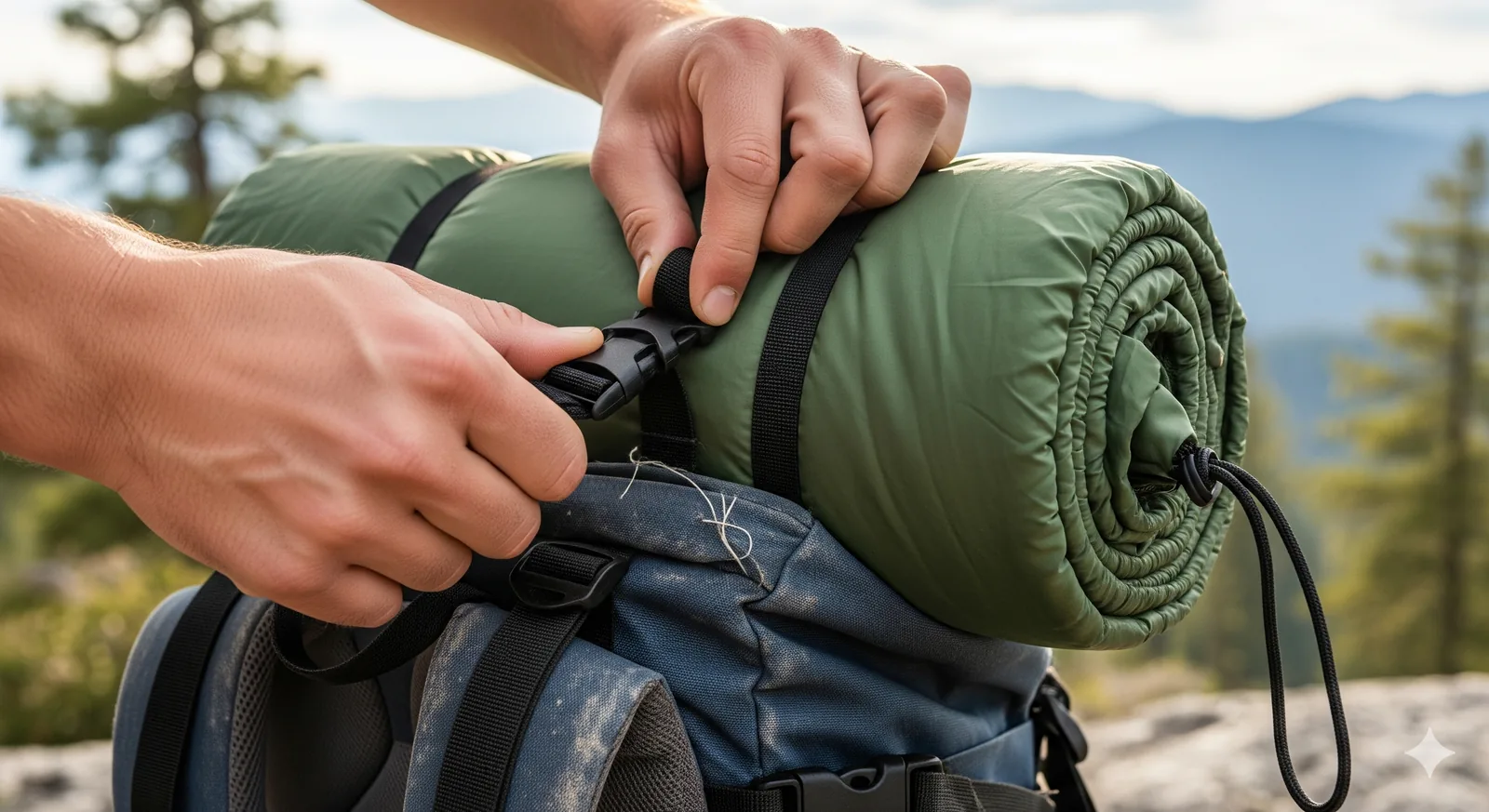
The classic method, and the one I use most. Thread the two straps through the anchors, lay the sleeping bag horizontally, well centred, and pull them tight. Tight means the sleeping bag must not be able to move when you push it with your hand.
Advantage: the weight stays low and close to your back, which does not upset the balance too much. Drawback: it is the position most exposed to mud and rubbing, and the sleeping bag touches the ground every time you put the pack down. That is why the waterproof sack matters.
Option 2: on top of the pack, under the lid
The sleeping bag is wedged between the body of the pack and the lid, held in place by the lid straps. It is quick, and the sleeping bag stays clean.
But it is the one I use least, because the weight rides very high. With a light 700 g sleeping bag, it works. With a two-kilo winter sleeping bag, the pack becomes unstable and pulls backwards on steep climbs. I tried it once and never did it again.
Option 3: on the side, with the side compression straps
The sleeping bag is fixed vertically along one side of the pack. It is useful when the bottom compartment is already taken, or for a very long sleeping bag.
The flaw shows from the very first steps. It pulls you off balance. You have to compensate on the other side with something of a similar weight, a full water bottle or a sleeping mat. Otherwise you walk lopsided for hours without noticing, which happened to me for a whole day.
Without straps: bungee cords, cord or carabiners
Smaller packs and daypacks often have no straps under the bottom. The outdoor guides that cover this question describe the same fallbacks:
- A bungee cord: hook one end into a loop on one side of the pack, wrap it tightly around the pack and the sleeping bag several times, then hook the other end on the opposite side.
- Cord or the stuff sack’s own straps: tie them to the pack’s gear loops or daisy chain, pulled tight.
- Carabiners: quick to clip on, but a sleeping bag hanging from a single carabiner swings with every step. Use two, or add cord, to hold it still.
The lesson of my descent in the Écrins applies here too. Whatever you use, tie it to points sewn onto the pack, not only around the sleeping bag. And as it is fully exposed out there, keep the sleeping bag in a waterproof sack.
The alternative: packing your sleeping bag inside the rucksack
Why I do it more and more
After strapping it outside time after time, I finally understood what it cost. The sleeping bag gets rained on, it picks up mud, it catches on branches, and above all it moves weight away from your back, which is exactly what you are trying to avoid.
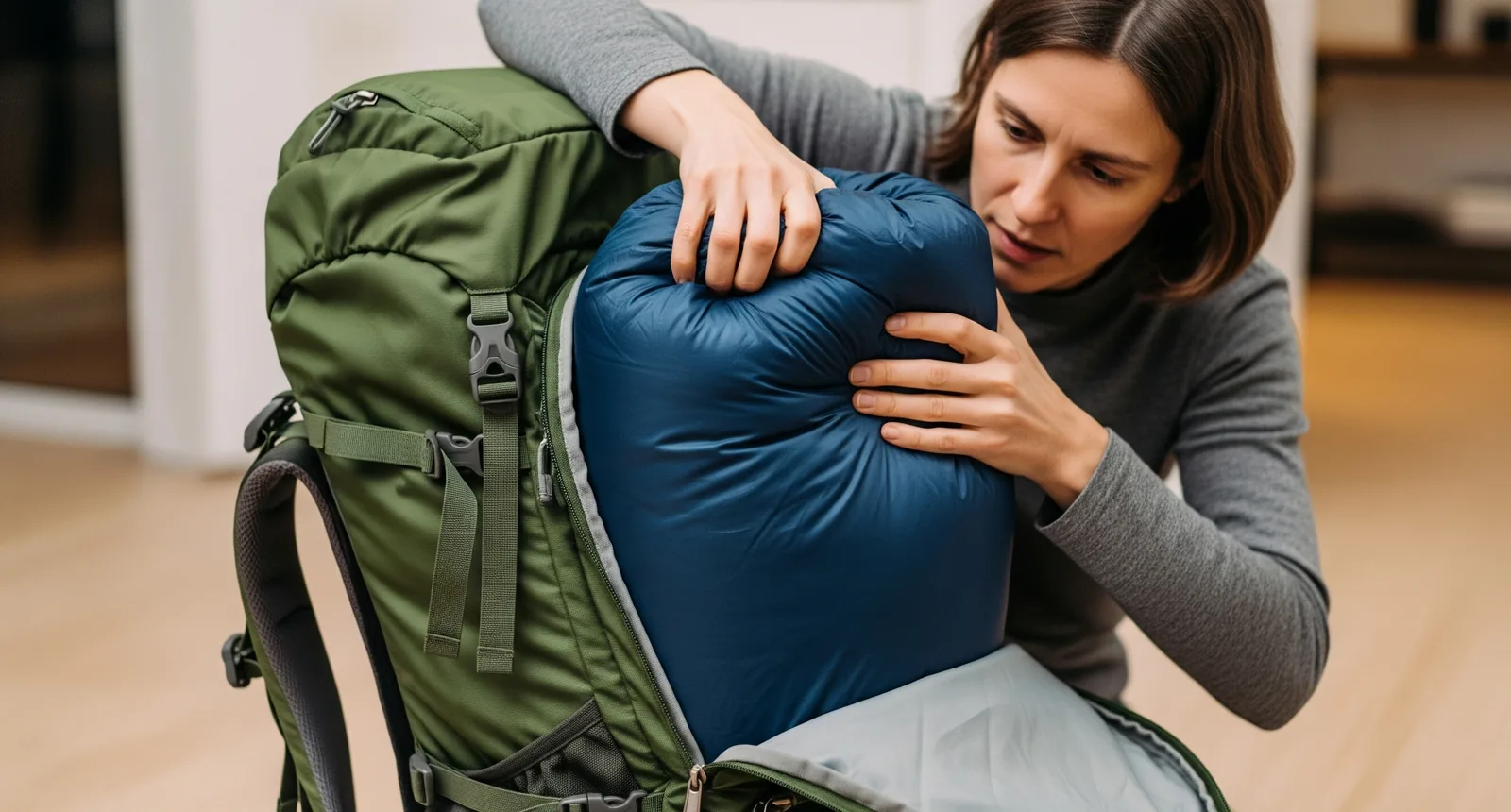
Today, as soon as there is room, I put it inside. That takes a big enough pack, around 50 litres for a compressed three-season sleeping bag. In a 40-litre pack, it rarely works.
I still strap it outside when the pack is genuinely full, or in dry weather with a light sleeping bag.
How to place it inside
Right at the bottom, in the bottom compartment if there is one. The sleeping bag is bulky but light, so it makes a soft base that gives the pack its shape without adding weight low down. The heavy kit goes in the middle, against your back.
A trick I use on packs that are a little tight is to take the sleeping bag out of its sack and stuff it straight into the bottom of the pack, pushing it into every corner. Paradoxically, it takes up less room than a rigid cylinder, which leaves gaps all around it. A little counter-intuitive, but it works.
What I learnt about balancing the pack
How a sleeping bag changes the way a pack carries
A sleeping bag weighs little but takes up a lot of space, which makes it the worst enemy of balance. Every centimetre that moves it away from your back adds leverage that pulls the pack backwards.
You can measure the difference in your legs. The same sleeping bag, strapped underneath and then packed inside, does not feel the same after two hours of climbing. With it inside, you stand straighter, and you look ahead rather than at your feet.
My rule is that the heavier the sleeping bag, the closer it should sit to your back and the nearer to mid-height. A winter sleeping bag should never end up at the top of the pack.
Protecting your kit
A wet down sleeping bag gives no warmth at all, and it takes more than a day to dry. My set-up since a sodden night of wild camping is a waterproof sack for the sleeping bag, a rain cover on the pack, and a separate dry bag for dry clothes.
The rain cover alone is not enough. Water runs down your back and gets in at the top, which I discovered with a damp sleeping bag one stormy evening. The styles in our waterproof backpacks collection limit the problem, but I still keep dry bags inside.
How to attach a sleeping bag securely: what to remember
If you remember only one thing, thread the straps through the anchor points, not just around the sleeping bag. That is what I had not done in the Écrins, and it is the only reason my sleeping bag ended up thirty metres further down.
Next, think about the inside before the outside. A sleeping bag packed inside carries better, stays dry and catches on nothing. Strapping it outside is a solution for lack of space, not a default choice.
And invest in a waterproof compression sack. It costs only a few pounds, halves the volume and settles the rain question in one go. For self-sufficient trips where space is the real issue, the styles in our hiking backpacks collection and the 90L hiking backpack for long-distance trekking, with its separate sleeping bag compartment, leave room to put everything inside.
To organise the rest of your kit, see my method for how to pack a hiking backpack and keep the things you need within reach on the trail.
Sleeping bag and backpack questions
What is the best way to attach a sleeping bag to a backpack?
Inside, whenever it fits, because it carries better, stays dry and catches on nothing. If it does not fit, strap it under the pack, with the two straps threaded through the anchor loops and pulled tight enough that the sleeping bag does not move when you push it.
Where should the sleeping bag go in a rucksack?
Inside, at the very bottom, in the bottom compartment if the pack has one, with the heavy kit in the middle against your back. Outside, the best place is under the pack, where the weight stays low and close to you. A winter sleeping bag should never go on top.
What can I do if my sleeping bag won’t fit in my backpack?
Start with a compression sack, which halves its volume. On a tight pack, also try the opposite and take the sleeping bag out of its sack, then stuff it loose into the bottom, where it fills the corners. If it still does not fit, strap it under the pack, or plan on a bigger pack next time, around 50 litres for a compressed three-season sleeping bag.
Can you attach a sleeping bag and a sleeping mat to a backpack?
Yes, but think about where the weight goes. Many packs have tie points at the base meant for a mat, and an inflatable mat is often small enough to go inside or in a side pocket, which leaves the base straps free for the sleeping bag. A mat strapped to one side can also balance a sleeping bag strapped to the other. Keep an eye on the total weight you carry outside, because all of it pulls you off balance.
Further reading
- See all our hiking backpacks
- The 90L trekking backpack for long-distance hikes
- Our travel backpacks